 Americano Padel Manager
 How Padel scoring works: complete guide to points
Padel scoring works like tennis: 15, 30, 40, game. A set is won at 6 games with a 2-game lead, and a match is played as best of 3 sets. But beyond this classic system, there are variants like the Golden Point, the Star Point (new in 2026), and the Americano format. Here is everything you need to know so you never get confused about the score again.
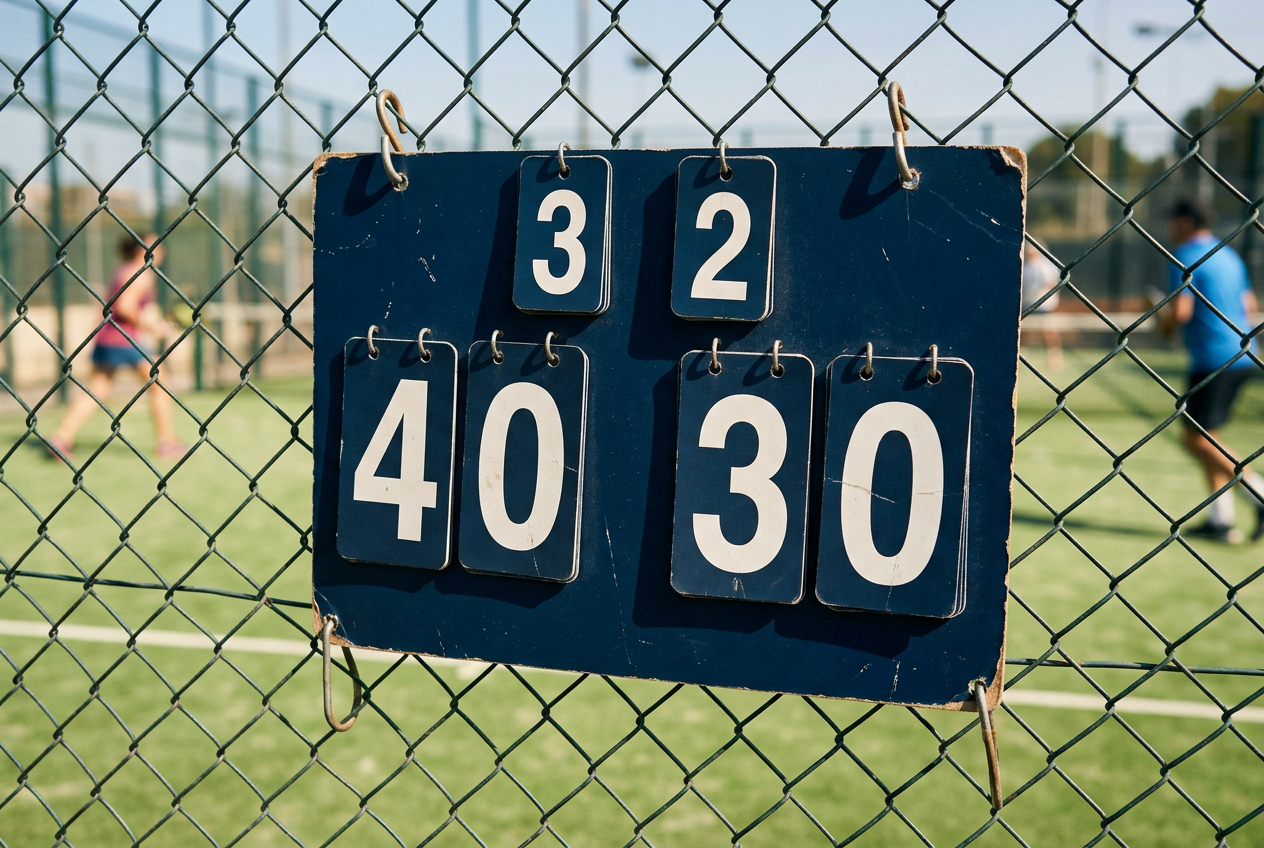
The classic Padel point system
Padel uses the same scoring system as tennis. If you already know tennis, you will be on familiar ground. If not, here is how it works.
Game scoring: 15, 30, 40
Each game unfolds as follows:
- 0 points won: 0 (called “zero” or “love”)
- 1st point won: 15
- 2nd point won: 30
- 3rd point won: 40
- 4th point won: game won (except when tied at 40-40)
The server always announces their score first. If you are serving and leading 2 points to 1, you call “30-15”. If your opponent is leading, you say “15-30”.
✓ Tip for beginners
Call out the score before every serve. It is a good habit that prevents misunderstandings and disputes on the court.
Deuce and advantage: what happens at 40-40?
When both teams reach 40-40, it is called “deuce”. From that point on, you must score 2 consecutive points to win the game:
- The team that wins the next point gets the “advantage”
- If that team wins the following point, they win the game
- If they lose the following point, the score goes back to deuce
This back-and-forth can last a long time. That is why variants like the Golden Point and the Star Point were introduced (more on that below).
Who calls the score and in what order?
The server calls the score before each serve. The rule is simple: the serving team’s score is announced first, then the receiving team’s score.
Examples:
- You are serving and leading 2-0 in points: “30-0”
- You are serving but your opponent leads: “15-40”
- Tied: “30-30” or “deuce” (at 40-40)
- You have the advantage: “advantage server” (or “advantage receiver” if it is the returner)
Sets and match: how to win a Padel match
A padel match is made up of sets, which are themselves made up of games. Here is how it all fits together.
Winning a set: 6 games with a 2-game lead
To win a set, a team must win 6 games with a minimum 2-game lead. The possible scenarios:
- 6-0, 6-1, 6-2, 6-3, 6-4: clear victory, the set is over
- 5-5: play continues. If one team wins, it becomes 6-5, and the other team still has to play one more game. At 6-5, the set is not over because there is only a 1-game lead
- 6-6: a tiebreak is played
The tiebreak at 6-6
When the score reaches 6 games all, a tiebreak is played. The tiebreak rules:
- Each point is worth 1 (you count 1, 2, 3, 4… not 15, 30, 40)
- The first team to reach 7 points wins, with a minimum 2-point lead
- If the score reaches 6-6 in the tiebreak, play continues until one team has a 2-point lead (7-5, 8-6, 9-7, etc.)
- The serve changes every 2 points (except after the first point)
The tiebreak counts as one game. The team that wins it takes the set 7-6.
The super tiebreak in the 3rd set
A padel match is played as best of 3 sets. If each team wins one set (1-1), a decider is needed. Depending on the tournament rules, there are two options:
- Full 3rd set: a complete standard set is played (used in official Premier Padel competitions)
- Super tiebreak: a tiebreak played to 10 points (with a 2-point lead) replaces the 3rd set. This is the most common format in clubs and amateur tournaments
The super tiebreak follows the same rules as the standard tiebreak, but is played to 10 points instead of 7.

How to keep score in Americano Padel
The Americano format uses a completely different scoring system from classic padel. It is simpler, faster, and perfectly suited to social tournaments.
Every point counts as 1
Forget the 15, 30, 40. In Americano, every point won is worth exactly 1 point. The match ends when the planned total of points is reached (for example, 32 total points between the two teams).
If your team wins 20-12, it means your team scored 20 points and your opponent scored 12, for a total of 32 points played.
Individual points vs team points
This is what makes the Americano format unique: you play as a team, but you score individually.
Practical example: You team up with Paul. You face Marie and Lucas. Final score: 18-14.
- You receive 18 points in the rankings
- Paul receives 18 points in the rankings
- Marie receives 14 points
- Lucas receives 14 points
Even the losers walk away with points. This is what makes the format fair: a player who narrowly loses all their matches (14-18, 15-17, 14-18) can finish ahead of someone who won one match but lost the others heavily.
Formats: 16, 24, or 32 points
The number of points per match affects the duration and pace of the tournament:
| Format | Average duration | Recommended for |
|---|---|---|
| 16 points | 6-8 min | Large groups (12+ players), limited time |
| 24 points | 10-12 min | Standard format, most popular |
| 32 points | 12-15 min | Small groups, experienced players |
The 24-point format is the most common. It offers the best balance between duration and strategy.
How to calculate the final rankings
The Americano rankings are simple: add up each player’s points across all their matches. The player with the most points wins the tournament.
Example with 4 players (24-point format):
| Match | Team 1 | Score | Team 2 |
|---|---|---|---|
| 1 | Alice + Bob | 14-10 | Clara + David |
| 2 | Alice + Clara | 12-12 | Bob + David |
| 3 | Alice + David | 16-8 | Bob + Clara |
Final rankings:
| Player | Match 1 | Match 2 | Match 3 | Total |
|---|---|---|---|---|
| Alice | 14 | 12 | 16 | 42 |
| David | 10 | 12 | 16 | 38 |
| Bob | 14 | 12 | 8 | 34 |
| Clara | 10 | 12 | 8 | 30 |
In case of a tie, players are ranked by: number of wins, then point difference (scored minus conceded), then head-to-head record.
Managing Americano scores with Americano Padel Manager
Doing all these calculations by hand quickly becomes a headache with 8, 12, or 16 players. That is exactly the problem Americano Padel Manager solves.
The app handles all the math:
- Real-time rankings: enter the scores for each match, and the rankings update instantly
- Automatic team rotation: the algorithm generates matches so every player faces and partners with everyone
- Live sharing: players follow the rankings on their phone via a shared link, without installing the app
- Multi-court support: manage up to 10 courts simultaneously, the app optimizes rotation to minimize waiting time
No more Excel spreadsheets or calculations on a napkin. In under 2 minutes, your Americano tournament is ready.

Golden Point, Star Point: Padel scoring variants
The classic advantage system can make games drag on. To speed up matches, two variants have been created over the years.
The Golden Point (punto de oro)
The Golden Point (or punto de oro) completely removes the advantage system. When the score reaches 40-40, a single decisive point is played:
- The receiving team chooses the side (right or left) from which the point will be played
- The team that wins this point wins the game outright
- No deuce, no advantage
This system was used on the World Padel Tour for several seasons. It reduces the average game duration by 18 to 25% and makes matches more intense. Every point at 40-40 becomes a moment of extreme tension.
The Star Point: the new 2026 rule
Introduced by the International Padel Federation (FIP) in December 2025, the Star Point is a compromise between the classic advantage and the Golden Point. It has been in effect on all professional circuits since January 2026 (Premier Padel, CUPRA FIP Tour, FIP Promises).
Here is how it works:
- 1st deuce: classic advantage system. If the team with the advantage loses, it goes back to deuce
- 2nd deuce: same thing, classic advantage
- 3rd deuce: the Star Point is played. One decisive point, the winner takes the game
In short, the Star Point allows a maximum of 3 deuces before a final point is played. This limits never-ending games while preserving the tension of the advantage system for the first two deuces.
FIP president Luigi Carraro explained that this rule “improves the spectacle without losing padel’s identity” and “protects player health” by preventing marathon games.
Advantage vs Golden Point vs Star Point: what is the difference?
| System | At 40-40 | Max number of deuces | Used where |
|---|---|---|---|
| Classic advantage | Must lead by 2 points | Unlimited | Friendly matches, some tournaments |
| Golden Point | 1 immediate decisive point | 0 | World Padel Tour (before 2024) |
| Star Point | Advantage then decisive point at 3rd deuce | 3 | Premier Padel, FIP Tour (since 2026) |
⚠️ Note
In club play and among friends, you are free to choose whichever system you prefer. The Star Point and Golden Point are only mandatory on official circuits. Agree on the rules before the match.
FAQ
How are points counted in padel?
Points are counted like in tennis: 15, 30, 40, game. At 40-40 (deuce), you need a 2-point lead to win the game (except with the Golden Point or Star Point). A set is won at 6 games with a 2-game lead, and a match is played as best of 3 sets.
What is the Star Point in padel?
The Star Point is a rule introduced in 2026 by the FIP. At the 3rd deuce of a game, a single decisive point is played. The first two deuces are played normally with the advantage system. This prevents never-ending games while keeping the tension of the classic advantage.
What is the difference between padel scoring and tennis scoring?
The point system is identical (15, 30, 40, game, set). The main difference concerns match format: in padel, the super tiebreak to 10 points often replaces the 3rd set in club play. Additionally, the Golden Point and Star Point are variants specific to professional padel.
How do you keep score in Americano padel?
In Americano, every point won counts as 1 (no 15, 30, 40). Matches are played to 16, 24, or 32 total points. Each player accumulates their points individually across all matches to determine the final tournament rankings.
How many sets do you need to win a padel match?
A padel match is played as best of 3 sets. If each team wins one set (1-1), a 3rd set or a super tiebreak to 10 points is played as a decider. The format depends on the tournament rules or the agreement between players.
Conclusion
Padel scoring is based on the same system as tennis: 15, 30, 40, game, set, match. Variants like the Golden Point and the 2026 Star Point simplify deuce situations, while the Americano format offers a radically different scoring system where every single point matters.
Whether you are playing a classic match with friends or an Americano tournament at your club, the key is to agree on the rules before you start. And if you are organizing a tournament, let Americano Padel Manager handle the calculations: download the app for free and focus on the game.