 Americano Padel Manager
 Padel vs Pickleball vs Squash: Which Racket Sport Should You Choose?
Padel, pickleball and squash are three booming racket sports, but they offer radically different experiences. Courts, equipment, rules, physical intensity: this guide compares everything to help you pick the sport that best fits your profile.
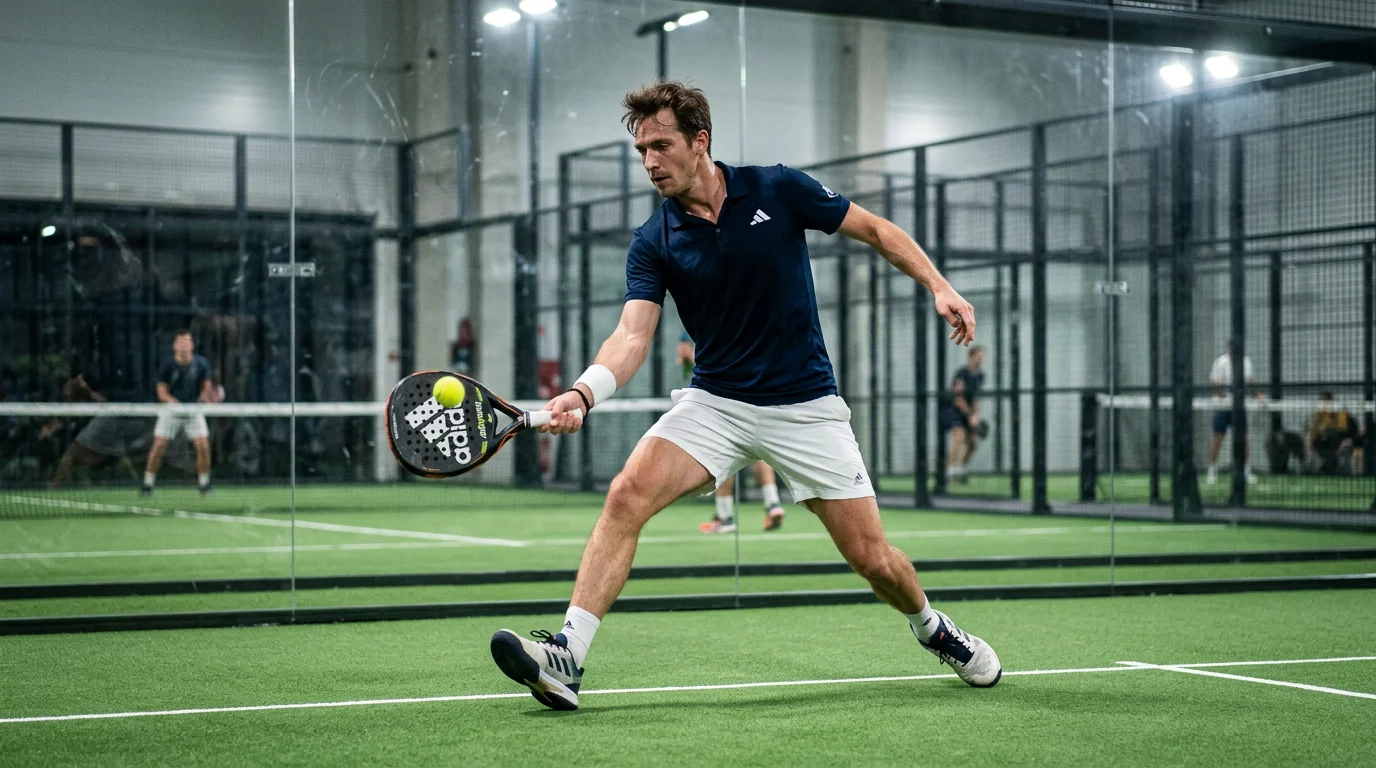
Three Sports, Three Playing Philosophies
Before diving into the technical details, it helps to understand what makes each sport unique. Beyond court dimensions and racket types, each sport is built around a fundamentally different playing philosophy.
Padel: The Ultimate Social Racket Sport
Padel is played exclusively as doubles on a court enclosed by glass walls and metal fencing. The walls are not an obstacle; they are part of the game. When the ball bounces in your half and then hits the glass wall, it stays in play. You can return it after the wall bounce, which extends rallies and creates unique tactical situations.
This mechanic is what makes padel so accessible. Rallies last longer, unforced errors are less frequent, and the doubles format encourages communication and team strategy. You do not need to be an athlete to enjoy yourself from the very first game.
Pickleball: Accessible and Explosive
Pickleball is played in singles or doubles on a small court with no walls, using a solid paddle and a perforated plastic ball. The pace is fast, rallies are short, and the “kitchen” (non-volley zone) near the net forces players to alternate between net attacks and baseline play.
It is the easiest racket sport to pick up. The court is compact, the ball is slow, and the rules are straightforward. It appeals especially to players of all ages looking for a fun sport that is easy on the joints.
Squash: Intensity and Precision
Squash is primarily played as singles in a fully enclosed box. All four walls are active playing surfaces: you hit the ball directly against the front wall, use the side walls to vary angles, and every rally demands constant repositioning.
Squash is considered one of the most physically demanding sports. Rallies are intense, space is limited, and shot placement is decisive. It requires cardio, agility, and sharp tactical awareness.
Court and Equipment Comparison
Court Dimensions and Layout
The three sports are played on very different surfaces.
| Criteria | Padel | Pickleball | Squash |
|---|---|---|---|
| Dimensions | 20 m x 10 m | 13.41 m x 6.10 m | 9.75 m x 6.40 m |
| Walls | Glass + fencing (partially enclosed) | None | 4 walls (fully enclosed) |
| Net | Yes (88 cm at center) | Yes (86 cm at center) | No |
| Surface | Artificial turf or carpet | Hard (concrete, asphalt, wood) | Hardwood or resin |
| Role of walls | Extend rallies | — | Direct attacking surface |
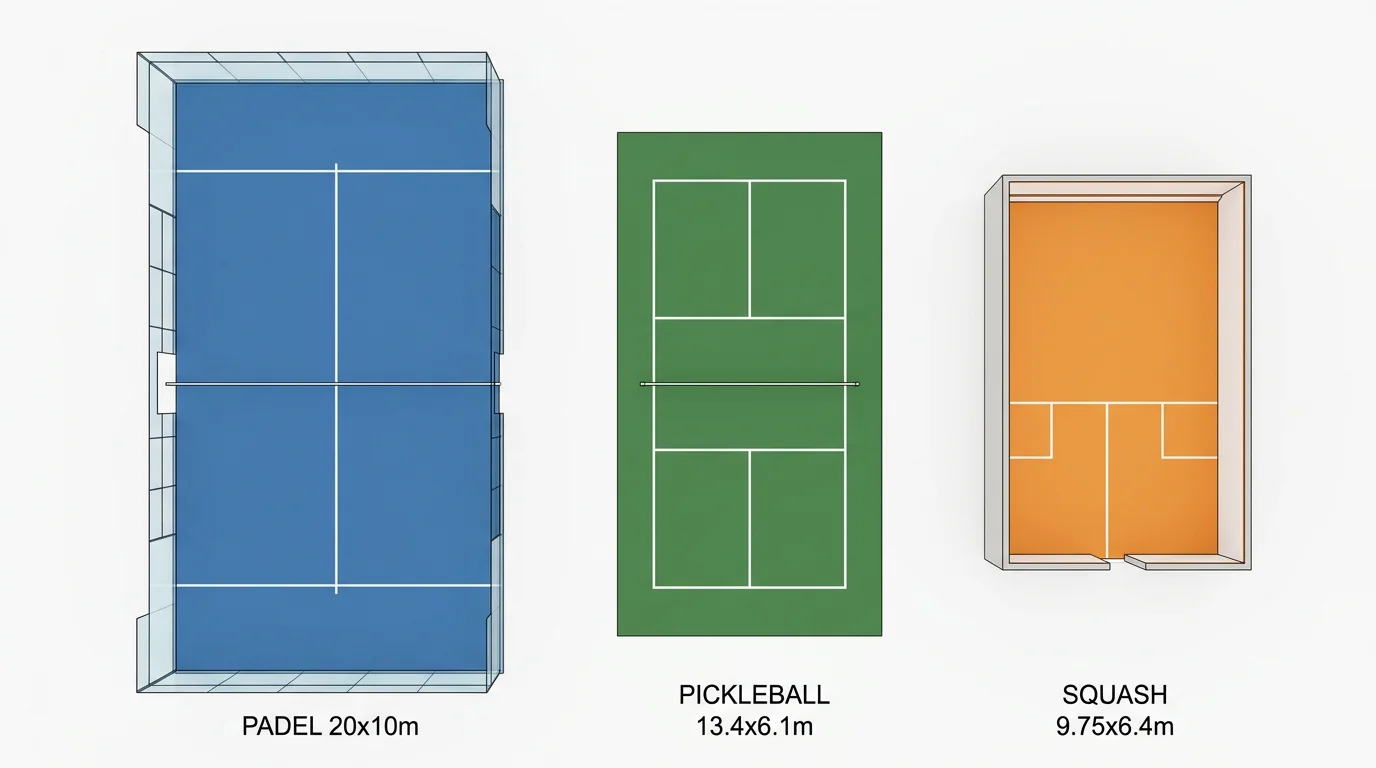
The padel court is the largest of the three. Its rear glass walls and side fencing create a semi-open space where spectators can follow the action. The pickleball court is roughly the size of a badminton court. The squash court is the smallest but also the most confined, since all four walls are in play.
Rackets and Balls: Very Different Tools
| Criteria | Padel | Pickleball | Squash |
|---|---|---|---|
| Racket type | Solid, perforated, stringless | Solid paddle, no holes | Strung, lightweight frame |
| Weight | Up to 370 g | 170 to 397 g | 110 to 175 g |
| Ball | Similar to tennis, less pressurized | Perforated plastic (wiffle-type) | Hollow rubber, small |
| Ball speed | Medium | Slow | Fast |
The padel racket comes in several shapes: round (control), diamond (power), or teardrop (versatility). The pickleball paddle is flat, without perforations, often made of graphite or composite. The squash racket is the only one of the three that uses a strung surface, allowing for greater spin and ball speed.
Rules and Scoring: Padel, Pickleball and Squash Head to Head
How Points Are Scored
The three sports use very different scoring systems.
Padel borrows the tennis scoring system: 15, 30, 40, game. A set is won at 6 games (with at least a 2-game lead), and a match is played as best of 3 sets. The serve is underhand, making it accessible for beginners.
Pickleball is played to 11 points (sometimes 15 or 21). Only the serving team can score. A unique rule requires a double bounce at the start of each point: the return of serve and the server’s next shot must each bounce before being played.
Squash uses the PAR (Point-A-Rally) system to 11 points. Unlike pickleball, either player can score on every rally, regardless of who is serving. If the score reaches 10-10, a 2-point lead is needed to win.
Singles, Doubles, or Both?
This is one of the major differences between the three sports.
- Padel: exclusively doubles (2 vs 2). It is a fundamentally team-based sport.
- Pickleball: singles or doubles. Doubles is the most popular format, but singles is played on the same court.
- Squash: primarily singles (1 vs 1). Doubles exists but remains uncommon and requires a larger court.
Padel: the champion of social play
The mandatory doubles format makes padel the most social racket sport. Every match involves 4 players, which encourages meeting new people, rotating partners, and building a group atmosphere. This is also what makes social tournaments particularly well suited to padel.
Which Sport Is Easiest to Learn?
Padel: The Most Accessible of the Three
Padel is often cited as the easiest racket sport to pick up. The underhand serve eliminates the technical difficulty of the tennis serve. The walls extend rallies and forgive placement errors. The doubles format lets you lean on your partner while you improve.
A beginner can enjoy their first session without frustration. Rallies develop naturally, and the fun is immediate.
Pickleball: Perfect for a Gentle Start
Pickleball offers a very gentle learning curve. The ball is slow, the court is small (less movement required), and the rules are intuitive. It is the ideal sport for players discovering racket sports or looking for a low-impact activity.
The format is also very flexible: you can play singles for more of a cardio challenge, or doubles for a more relaxed experience.
Squash: The Steepest Learning Curve
Squash has the steepest learning curve of the three. The enclosed court, ball speed, and the need to read bounces off all four walls take time to master. Positioning is crucial, and a beginner can find themselves constantly behind the ball.
On the other hand, squash rewards dedication. Progression is gratifying, and the level of tactical depth that can be reached is impressive.
Physical Demands and Health Benefits
All three sports provide an excellent cardiovascular workout, but at different intensity levels.
| Criteria | Padel | Pickleball | Squash |
|---|---|---|---|
| Intensity | Moderate to high | Low to moderate | High to very high |
| Calories/hour | 400-600 | 250-400 | 500-800 |
| Joint impact | Moderate | Low | High |
| Muscles used | Legs, core, shoulders | Arms, shoulders, legs | Full body |
Squash is regularly ranked among the most complete sports in the world. Short sprints, direction changes, and explosive shots engage the entire body. Padel offers a good balance between physical effort and accessibility. Pickleball is the least demanding, making it a preferred choice for senior players or those returning to physical activity.
Popularity and Global Growth
Padel: 35 Million Players and Record Growth
Padel is the fastest-growing racket sport in the world. According to the FIP World Padel Report 2025, there are over 35 million players across 130 countries. The number of courts has reached 77,300 worldwide, up 15.2% in a single year. More than 24,600 clubs now offer padel.
Born in Mexico in the late 1960s, padel first took hold in Spain and Argentina before conquering Europe. Italy, Sweden, Belgium, and the United Kingdom are experiencing an explosion in player numbers. In the UK, the number of players tripled between 2023 and 2024, rising from 129,000 to over 400,000.
Pickleball: An American Phenomenon Expanding Worldwide
Pickleball has approximately 22.7 million players in the United States as of 2025, a 14.7% increase in one year. Globally, the sport brings together more than 5 million active players across 84 countries.
Born in 1965 in Washington State, pickleball remained under the radar for decades before exploding in the 2020s. Its growth is concentrated in North America, but India (50,000 players) and Australia (92,000 players) are starting to follow.
Squash: 185 Countries and the 2028 Olympics
Squash has over 20 million players in 185 countries, with 116 national federations affiliated with the World Squash Federation. It is the most geographically established racket sport, with historical strongholds in Egypt, Pakistan, and England.
The major milestone for squash: its inclusion in the 2028 Los Angeles Olympic Games. After four unsuccessful bids, squash will finally make its Olympic debut at the Universal City Squash Center. This could reignite global interest in the sport and attract a new generation of players.
Organizing a Tournament: The Padel Advantage
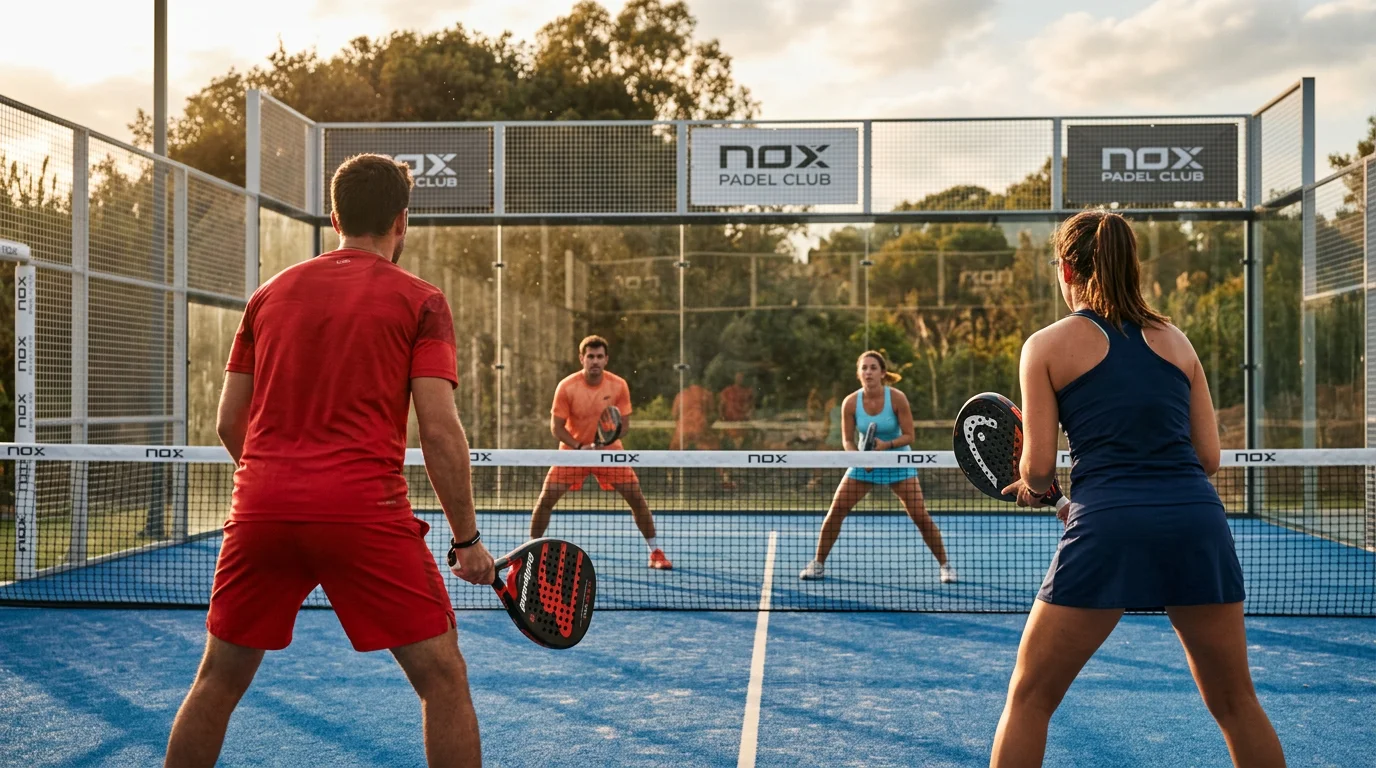
Padel stands out not only for its gameplay. It is also the racket sport best suited for social tournaments thanks to its unique formats.
Americano and Mexicano Formats
The Americano format is the most popular tournament mode in padel. Each player teams up with a different partner every match and faces different opponents. At the end of the tournament, the player with the most individual points wins. It is a perfect format for mixing skill levels and encouraging new connections.
The Mexicano format takes it further: matches are organized based on the live standings. Top-ranked players face each other, ensuring balanced matches throughout the tournament. To learn more about these formats, check out our complete guide to Americano Padel rules.
Run a Tournament in Minutes with Americano Padel Manager
Organizing an Americano or Mexicano tournament normally requires calculating rotations, managing scores, and maintaining standings. With Americano Padel Manager, everything is done in a few taps.
The app automatically generates matches with optimal player rotation, displays the live standings, and lets you share results via a web link accessible on phone, tablet, or TV screen. It handles 4 to 40 players and supports up to 10 courts simultaneously.
Whether you are organizing a session with friends or a club event, Americano Padel Manager turns organization into a 2-minute task. The app is free, available on iOS and Android, and works even without an internet connection.
Summary Table: Padel vs Pickleball vs Squash
| Criteria | Padel | Pickleball | Squash |
|---|---|---|---|
| Court | 20 x 10 m, glass walls | 13.4 x 6.1 m, open | 9.75 x 6.4 m, 4 walls |
| Racket | Solid, perforated | Solid paddle | Strung |
| Format | Doubles only | Singles or doubles | Primarily singles |
| Scoring | Tennis (15-30-40) | 11 points, server scores | 11 points, PAR |
| Difficulty | Easy | Very easy | Difficult |
| Intensity | Moderate | Low to moderate | High |
| Global players | 35 million | 22.7M (USA) / 5M (worldwide) | 20 million |
| Olympics | No | No | 2028 (Los Angeles) |
| Social tournaments | Americano, Mexicano | Standard tournaments | Standard tournaments |
| Best for | Groups, clubs, social play | Beginners, seniors | Competitors, cardio |
FAQ
What is the main difference between padel and pickleball?
Padel is played as doubles on a court with glass walls that are part of the game. Pickleball is played on a smaller open court, in singles or doubles, with a perforated plastic ball. Padel emphasizes team tactics and wall play, while pickleball focuses on reflexes and net play.
Is padel harder than squash?
No, padel is generally easier to learn than squash. The underhand serve, doubles format, and walls that extend rallies make padel accessible from the very first session. Squash requires more physical fitness, better reading of wall bounces, and stronger positional awareness.
Which racket sport burns the most calories?
Squash is the most physically demanding, burning 500 to 800 calories per hour. Padel comes in at 400 to 600 calories per hour, and pickleball at 250 to 400 calories per hour. These figures vary depending on playing intensity and player level.
Can you play padel in singles?
Padel is designed for doubles (2 vs 2). While some courts allow singles play, the format is not official, and the 20 x 10 m court is too large for a single player. If you prefer playing alone, squash or pickleball are better options.
Will squash be at the Olympics?
Yes. Squash will make its Olympic debut at the 2028 Los Angeles Games. After four rejected bids, the IOC approved its inclusion with two events (men’s and women’s singles) to be held at the Universal City Squash Center.
Pick Your Sport and Get Started
Each sport has its strengths. Squash is built for those seeking intensity and individual challenge. Pickleball suits those who want an accessible and versatile sport. And padel stands out as the ideal choice for those who love playing in groups, sharing moments on the court, and organizing tournaments with friends or at the club.
If padel appeals to you, download Americano Padel Manager to organize your first tournament in under 2 minutes. The app is free, used in over 75 countries, and rated 4.9/5 by players.