 Americano Padel Manager
 Americano padel tournament in 2 hours: how to run the perfect format
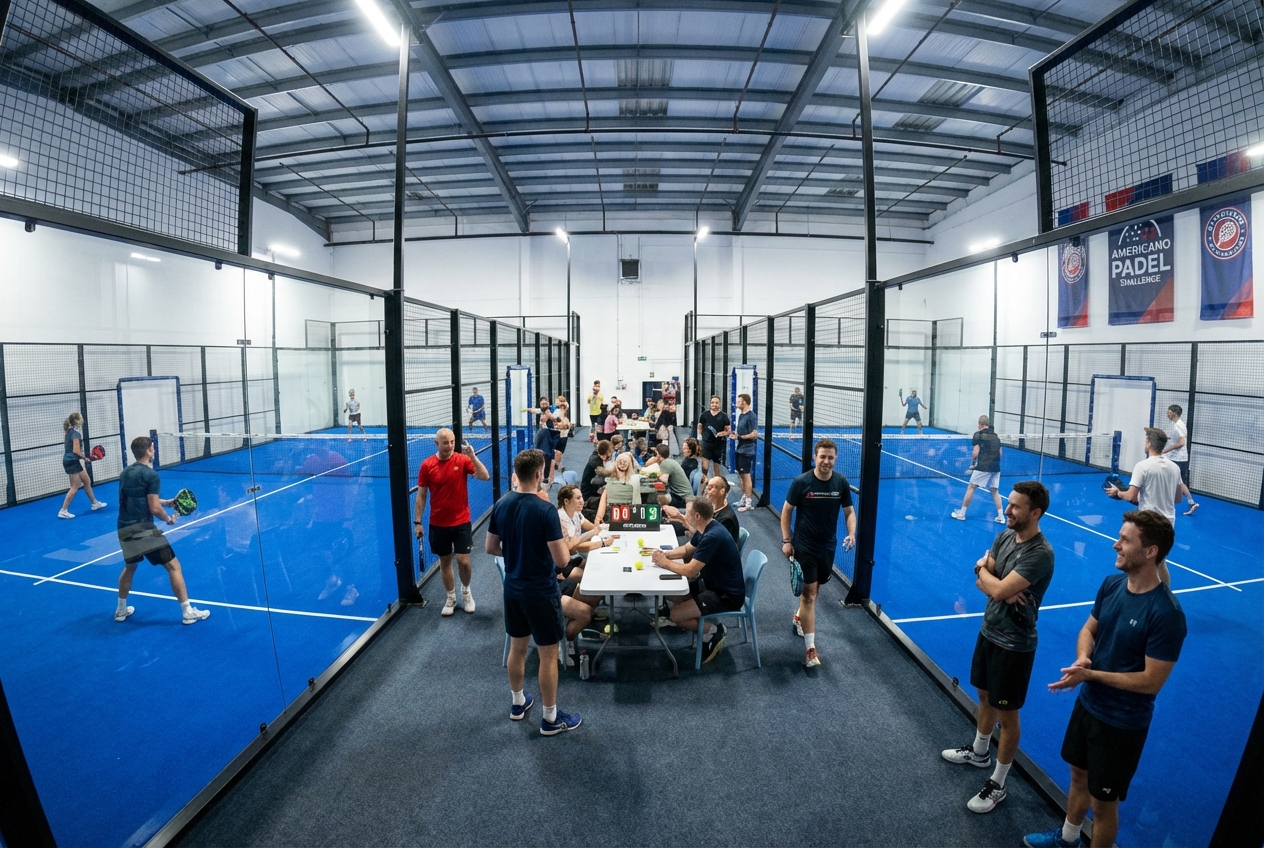
Running an Americano tournament in a 2-hour slot is entirely achievable. With 8 players on 2 courts and 24-point matches, you fit 7 complete rounds of play into the time available — as long as you don’t wing the transitions. Here’s how to structure every minute so you never run over.
Why 2 hours is the number one constraint for padel tournament organisers
Padel court bookings come in fixed slots. One hour, two hours, rarely more. Organisers who run weekly club sessions or corporate events all come back with the same question: how many players can we register and get on court within the available time?
The good news: the Americano format is perfectly calibrated for short slots. All participants play simultaneously on the available courts, rounds flow quickly, and the absence of elimination means nobody sits waiting. This social format naturally fits within 2 hours for the most common configurations.
The bad news: without a clear structure, transitions between rounds end up eating 30 to 40 minutes of the total time. And that’s when you run over.
✓ Americano: social and competitive in equal measure
Accessible to all levels — beginners, intermediates or advanced — and ideal for mixed or single-gender groups, Americano is today the most widely played padel tournament format in clubs. The rotation of partners and opponents every round guarantees a balanced competition and a friendly atmosphere right through to the final match.
The winning setup: 3 variables to lock in before opening registrations
Number of players: 8 participants, the ideal target
For a 2-hour slot, 8 players on 2 courts is the most robust configuration. It delivers 7 rounds in full rotation, meaning 7 matches per player. Each participant plays alongside and against every other player at least once — the final standings genuinely reflect each player’s level.
With 12 players on 3 courts, you push up against the slot limit: 11 full rounds often exceed 2 hours, unless you play to 16 points or cap at 9–10 rounds.
⚠️ 12 players in 2h is tight
It’s doable, but it demands strict transition management and 16-point matches rather than 24. Better to plan for a maximum of 9 rounds and announce a partial standings at the end of the session.
Match format: 24 points for most groups, 16 points for larger ones
The number of points per match is the main lever controlling total duration and effective playing time per player.
| Format | Match duration | Possible rounds in 2h (8 players) |
|---|---|---|
| 16 points | 7–9 min | 9–10 rounds |
| 24 points | 10–13 min | 7 rounds (full rotation) |
| 32 points | 14–18 min | 5–6 rounds |
For 8 players with a 2-hour slot, 24 points remains the best option. It gives matches that are long enough to be competitive with genuine rallies, and 7 rounds fits comfortably within the time available. 32-point matches are reserved for small groups of 4 to 6 players when there is plenty of time.
For larger groups (12 players on 3 courts), dropping to 16 points is often the only way to stay within 2 hours without cutting the rotation short.
Timed format vs points format: when to choose which
An often underestimated alternative: fixed-time matches. Rather than playing to a target score, each match lasts exactly 12 or 15 minutes regardless of the result and the level of the pairs on court.
Advantage: the total competition duration is guaranteed. Whatever the pace of play, every round ends at the same time on all courts. This is the most reliable option when the booking slot is strict.
Disadvantage: close matches sometimes stop mid-flow, which some players find less satisfying than a clean final score.
In practice, the points format suits the vast majority of groups and levels. Reserve the timed format for contexts where running over is truly unacceptable: corporate events, clubs with back-to-back slots, or official competitions with a tight schedule.
Americano Padel Manager: the tool that eliminates the 30 minutes lost between rounds
The biggest time drain in an Americano tournament is not the matches themselves. It’s the transitions between rounds: calculating new pairings, announcing the pairs, logging scores and organising court changes.
Without a dedicated tool, one transition takes 4 to 7 minutes. Over 7 rounds, that adds up to 28 to 49 minutes of time not spent on court. This is where 2-hour slots overrun, even with a punctual and motivated group.

Americano Padel Manager compresses these transitions to under 2 minutes per round. The app automatically generates optimal pairings for each round taking match history into account, displays the next round schedule before the current round is even finished, and updates the standings in real time as results are entered.
Over a 7-round tournament with 8 players, the difference amounts to 20 to 35 minutes saved — the gap between finishing on time and spilling into the next slot.
Other features useful for short slots:
- Odd-number player management: 9, 10 or 11 players? The app automatically distributes breaks fairly across participants, with no manual calculation.
- Multi-court support: up to 10 courts managed simultaneously. Large club sessions with 20 or more players remain manageable.
- Works offline: no dependency on the club’s Wi-Fi or mobile signal.
- Shareable results: send a link so participants can check the standings from their phone in real time.
Used in over 75 countries by thousands of clubs, the app is free with a 7-day trial of premium features.
The minute-by-minute match plan
Having the right setup and the right tool is good. Having a precise sequence to follow on the day is what stops you from improvising.
The evening before: 20 minutes of preparation
- Confirm the final list of registered players (last-minute absentees change everything about the rotation)
- Create the tournament in the app, enter player names and select the points format
- Verify that the number of reserved courts matches the number of players (1 court per 4 participants)
- Send the basic rules to players to avoid questions at the start
On-site, the first 10 minutes
The first few minutes set the tempo for the entire session. Organisers who fumble them spend the rest of the time catching up.
10 minutes before the start: open the app, check the list of players present, adjust if needed and launch the first round.
At the start: explain the format rules in 2 minutes, no more. Players don’t need to understand every edge case upfront — the essentials are how points are counted and what happens between rounds. Everything else gets sorted as the competition unfolds.
During the first round: show a second participant how to enter scores in the app. Having an additional score-keeper means you’re not dependent on one person for every transition.
During the competition
- Enter each match result as soon as the game ends, without waiting for the full round to finish
- Announce the next round 1 to 2 minutes before the current round ends (players prepare to change pairs while the last point is still being played)
- Display interim standings after round 4: this reignites motivation and gives players further from the podium a target for the second half of the tournament
The final 15 minutes
Announce the final round out loud. Some players lose count of the rounds: if nobody signals that it’s the last rotation, the end of the competition catches everyone off guard and creates a disorganised finish.
Allow 5 minutes after the last match to display the final standings, congratulate the winners and thank all participants. This is the moment players will remember.

Organiser checklist: what actually makes the difference
To check before starting the session:
- The player list is confirmed (ideally a multiple of 4 to avoid bye rounds)
- The points format is suited to the group and the booking slot
- The app is set up, the first round is ready to launch
- At least one person other than the organiser knows how to enter scores
To avoid at all costs:
- Waiting for all players to arrive before creating the tournament in the app (set it up beforehand, adjust for absentees at the last moment)
- Explaining the rules for more than 3 minutes at the start
- Entering results at the end of the competition rather than after each round (you lose data and precious minutes)
- Playing to 32 points with 8 players in a 2-hour slot (the full rotation won’t fit)
Frequently asked questions
Can you run an Americano with 8 players on a single court in 2 hours?
Technically yes, but half the participants are waiting every round. With 1 court for 8 players, you need 7 rounds at 10–15 minutes each — about 1h15 of effective playing time — but the 4 players sitting out are inactive throughout. This isn’t in the spirit of the Americano format. Book 2 courts for 8 players: everyone plays at the same time, which is what makes the competition sociable and dynamic.
What should you do if a match isn't finished when the slot ends?
Two options: either apply the score at the whistle (each pair keeps the points earned up to that moment), or cancel the round and display the standings without that last result. The first option is fairer from a sporting perspective. The key is to announce this to players in advance to avoid disputes at the end of the session.
How many rounds can you play with 12 players in 2 hours?
With 12 players on 3 courts at 24 points, expect 9 to 10 rounds in a 2-hour slot. The full rotation would be 11 rounds, which slightly exceeds the time. Limiting to 9 rounds gives a perfectly valid final standings and keeps a comfortable buffer. To complete the full rotation, drop to 16 points: you’ll finish all 11 rounds in 2 hours with a few minutes to spare.
Should you schedule a break in a 2-hour tournament?
No, the Americano format doesn’t require a formal break. The transitions between rounds (1 to 3 minutes) are enough to drink, recover and sort the new pairs. Adding a 10-minute break in a 2-hour slot costs you 1 to 2 rounds of competition. If the group needs more recovery time between matches, book a 2.5-hour slot from the outset.
Is the 2-hour Americano format suitable for beginners or mixed-level groups?
Yes, and it’s actually one of its strengths. Beginners often play shorter, faster points than advanced players, which can paradoxically speed the session up. The rotation of partners and opponents ensures nobody is stuck against a level far above their own for the whole tournament — every player changes pairs each round. For mixed men and women groups, Americano is particularly well-suited as pairs rotate constantly and team balance emerges naturally across the full competition. For more on the format rules, check our complete Americano padel rules guide.
To wrap up
A 2-hour Americano tournament is realistic for 8 players and entirely achievable for 12 with the right configuration. The limiting factor is almost never the play itself: it’s the time lost between rounds on transitions, pairings and score entry.
Pick the right points format, set up your player list the evening before in Americano Padel Manager, and the 2 hours fill themselves — without spilling into the next slot, without last-minute improvisation, and with a final standings every player can check in a single tap. For more on the full organisation of your session, also read our guide to organising an Americano padel tournament and our article on Americano tournament duration. Download the app for free and test it before your next padel session.