 Americano Padel Manager
 Americano or Mexicano: which format for your padel tournament?
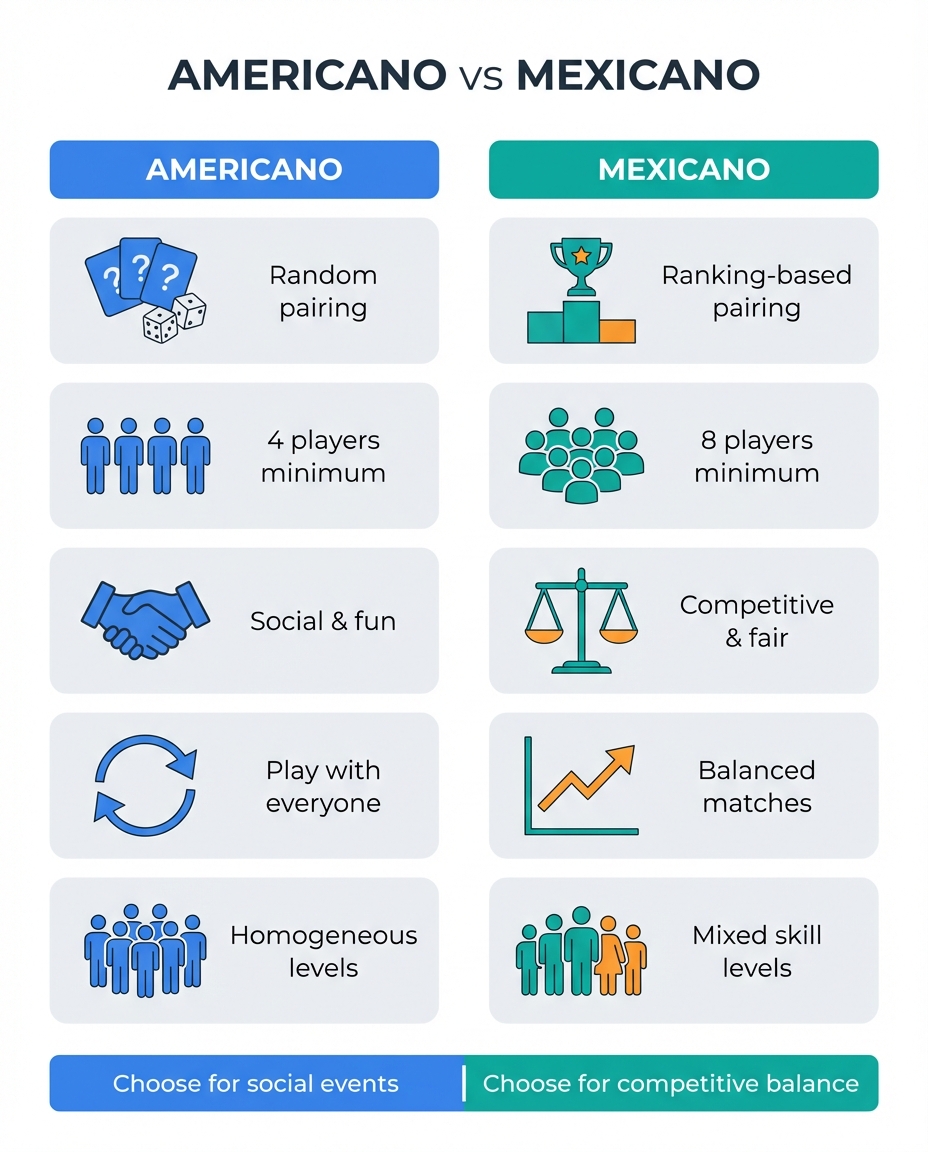
Americano and Mexicano are the two most popular padel tournament formats in clubs. The first focuses on social mixing (everyone plays with everyone), the second on competitive balance (matches become increasingly tight). This guide compares both formats in detail and helps you choose the one that fits your group.
The scoring is identical — only the pairing method differs
This is the most common misconception: many players think Americano and Mexicano use different point systems. In reality, the scoring is strictly the same.
Each match is played to a fixed number of points set in advance (16, 24 or 32). Points are split between the two teams: if a 24-point match ends 15 to 9, both players on the winning team each receive 15 individual points, and both players on the losing team receive 9. All points in the match are always distributed.
The only difference between the two formats is the team composition: random in Americano, dictated by the standings in Mexicano.
Americano: play with everyone
How it works
In Americano, pairs change every round following a rotation algorithm. The goal: each player is partnered with every other player exactly once during the tournament. All matches are scheduled from the start, meaning there is no waiting between rounds to calculate the next pairings.
The total number of matches follows a simple formula: players x (players − 1) / 4. With 8 players, that gives 14 matches across 7 rounds. With 12 players, 33 matches across 11 rounds.
Who it is ideal for
Americano is the go-to format for club evenings, corporate events and sessions with friends. Its strength: social mixing. You meet and play with everyone in the group, making it the best format for breaking the ice and building connections.
It is also the simplest format to organise. With just 4 players and a single court, you can already run a tournament. Americano does not require recalculating pairings between rounds since the bracket is generated in advance.
✓ The icebreaker format
Americano is the only format that guarantees every player plays at least once with every other player. It is the natural choice when participants do not all know each other.
Format limitations
Americano does not adapt as the tournament progresses. If a very strong player is consistently paired with strong partners by chance, this can unbalance matches. With very mixed skill levels, some encounters can become one-sided affairs.
Another point: with a large number of players, the format becomes lengthy. An Americano with 16 players means 60 matches across 15 rounds. Expect around 2h30 for a 24-point match.
Mexicano: increasingly tight matches
How it works
The first round is identical to Americano: randomly drawn pairs. But from the second round onwards, the live standings take over. Players are sorted by cumulative points, grouped in sets of 4 (one per court), and teams are formed by crossing skill levels.
Within each group of 4 players, the pairing works as follows: 1st is paired with 4th, and 2nd with 3rd. This crossover produces teams of comparable overall strength. The same principle applies on each court (5+8 vs 6+7, 9+12 vs 10+11, etc.).

Who it is ideal for
Mexicano is the recommended format when your group mixes very different skill levels. The dynamic pairing system self-balances: strong players face increasingly tough opponents, while struggling players end up together with matches at their level.
It is also the preferred format for clubs running weekly competitive evenings. The real-time standings keep all participants engaged, from first to last on the leaderboard.
✓ The self-balancing format
From the 3rd or 4th round, the standings have stabilised enough for matches to become very tight for everyone. This effect is what makes Mexicano addictive.
Format limitations
Mexicano requires a minimum of 8 players and 2 courts to work. It cannot be played with 4 or 6 players.
Another constraint: you must wait for all matches in a round to finish before launching the next one, since the pairings for the next round depend on current results. Without an app, this calculation takes 2 to 3 minutes between each round. With an app like Americano Padel Manager, it is instant.
Finally, you are not guaranteed to play with everyone. If you are at the top of the standings, you may never face players at the bottom. Social mixing is therefore lower than in Americano.
Side-by-side comparison
| Criterion | Americano | Mexicano |
|---|---|---|
| Pairing | Random rotation, pre-calculated | Dynamic, based on standings |
| Minimum players | 4 | 8 |
| Minimum courts | 1 | 2 |
| Scoring | Individual cumulative points | Individual cumulative points (identical) |
| Social mixing | Maximum (everyone plays with everyone) | Partial (dictated by standings) |
| Match balance | Variable (depends on the draw) | Progressive (self-balancing) |
| Time between rounds | None (pre-generated bracket) | 2 to 3 min (pairings recalculated) |
| Organisational complexity | Simple (possible on paper) | Requires an app or spreadsheet |
| Variants | Classic, Team, Mixed | Classic, Team, Mixed |
| Ideal for | Social evenings, icebreaker, small groups | Competition, mixed levels, large groups |
3 questions to choose the right format
1. How many players do you have?
If you have 4 to 7 players, the choice is made: only Americano works (Mexicano requires at least 8 players and 2 courts).
From 8 players onwards, both formats are possible. But the padel community is fairly unanimous: below 12 players, Americano remains more interesting because you play with everyone. Mexicano really comes into its own from 12 players and 3 courts, when the number of possible combinations makes a full social mix difficult.
2. What is the skill gap in your group?
If skill levels are relatively even, Americano offers the best experience: varied matches, surprises and social mixing.
If your group mixes beginners and experienced players, Mexicano is clearly better suited. Its pairing system prevents unbalanced matches by naturally grouping players by level after 2 to 3 rounds.
3. What atmosphere are you aiming for?
Social atmosphere (afterwork, icebreaker, team building) → Americano. The format pushes every player to interact with the whole group.
Competitive atmosphere (club evening, weekly standings, ranking) → Mexicano. The dynamic standings create growing sporting tension and tight matches towards the end of the tournament.
✓ In summary
Small group or social evening → Americano. Large group with mixed levels or competitive atmosphere → Mexicano. When in doubt, start with Americano: it is the simplest to launch and the most inclusive.
The variants nobody mentions: Team and Mixed
Most comparison guides stop at the classic versions. Yet Americano and Mexicano each exist in 3 variants, making 6 formats in total.
Team Americano and Team Mexicano
In the Team versions, pairs are fixed throughout the tournament. You choose your partner before the competition starts and play together until the end.
In Team Americano, each pair faces all other pairs (classic round-robin). In Team Mexicano, matchups are determined by the live standings, exactly as in Classic, but at team level.
These variants are ideal when players arrive as a duo (couples, regular partners) or when you want to reward team cohesion.
Mixed Americano and Mixed Mexicano
The Mixed versions require each pair to consist of one man and one woman. The rotation algorithm guarantees gender balance in every round.
Mixed Americano is a staple of mixed club evenings. Each player meets every partner of the opposite gender across the rounds. Mixed Mexicano combines the gender constraint with dynamic skill-based pairing.
⚠️ Condition for Mixed
Mixed variants require an equal number of men and women. If your group is unbalanced, opt for the Classic versions.
Organising your tournament with Americano Padel Manager
Whether it is an Americano with 6 players on one court or a Mexicano with 24 players on 6 courts, Americano Padel Manager handles all 6 formats (Classic, Team and Mixed for both) and automates the entire process.
The app manages 4 to 40 players, regardless of the number (no need for it to be a multiple of 4). For players who outnumber the spots, the algorithm distributes breaks fairly so no one sits out too long.
On the practical side:
- Automatic generation: the match bracket is calculated in one tap, including multi-court management (up to 10 courts)
- Real-time standings: every player follows their progress from their phone
- Offline mode: no wifi needed at the club, everything works without a connection
- Web sharing: a unique link to display the tournament on a TV or screen at the club
A 12-player tournament is set up in under 2 minutes. No more Excel sheets, no more calculations between rounds: enter the scores and let the app handle the rest.
FAQ
What is the real difference between Americano and Mexicano in padel?
The scoring is identical in both formats: every point scored adds to the player’s individual total. The only difference is the pairing method. In Americano, pairs change according to a pre-calculated rotation so that everyone plays together. In Mexicano, pairs are formed based on the live standings, which produces increasingly balanced matches.
Can you play Mexicano with only 8 players?
It is possible but not recommended. With 8 players on 2 courts, combinations are limited and you risk facing the same people multiple times. The padel community generally agrees that Mexicano truly shines from 12 players and 3 courts. For 8 players, Americano offers a better experience.
Which format is quickest to organise?
Americano is simpler to set up. All matches are generated in advance and there is no waiting time between rounds to recalculate pairings. Mexicano requires a tool (app or spreadsheet) to recalculate pairings after each round. With an app like Americano Padel Manager, both formats are set up in under 2 minutes.
How long does an Americano or Mexicano tournament last?
With 24-point matches (~12 minutes per match), expect around 1h30 for 8 players, 2h for 12 players and 2h30 for 16 players. The duration is comparable between both formats. Mexicano adds 2 to 3 minutes between each round for recalculating pairings, but this time is negligible with an app.
Is there a mixed men/women format?
Yes, both formats offer a Mixed variant. In Mixed Americano, each pair consists of one man and one woman, and rotations guarantee that each player meets all partners of the opposite gender. In Mixed Mexicano, the gender constraint is combined with dynamic ranking-based pairing. Mixed variants require an equal number of men and women.
Conclusion
Americano and Mexicano are not in opposition: they serve different needs. Americano maximises social mixing and conviviality. Mexicano optimises competitive balance and match intensity.
For a small group or a social evening, go with Americano. For a large group with varied levels or a competitive atmosphere, choose Mexicano. And in both cases, the Team and Mixed variants further expand the possibilities.
Download Americano Padel Manager to organise your next tournament in under 2 minutes, whatever format you choose. The app handles all 6 variants, from 4 to 40 players, and works even without an internet connection.