 Americano Padel Manager
 Complete padel accessories guide: equipment for players and tournament organizers
The essential padel accessories are: sport-specific shoes, a quality overgrip and a frame protector (bumper). After those come technical clothing, a bag with a thermal compartment, a ball pressurizer and injury prevention gear. This guide covers every category with a budget breakdown for each player profile.
You have your racket and you’re ready to play. Yet a player poorly equipped on the accessories side faces real risks: a sprained ankle from the wrong shoes, tennis elbow made worse by a worn overgrip, a racket damaged in a hot car boot in summer. The equipment around the pala matters as much as the pala itself.
This guide covers everything you need, from the bare minimum to the full competitor kit, plus a bonus section that is often overlooked: gear for the tournament organizer.
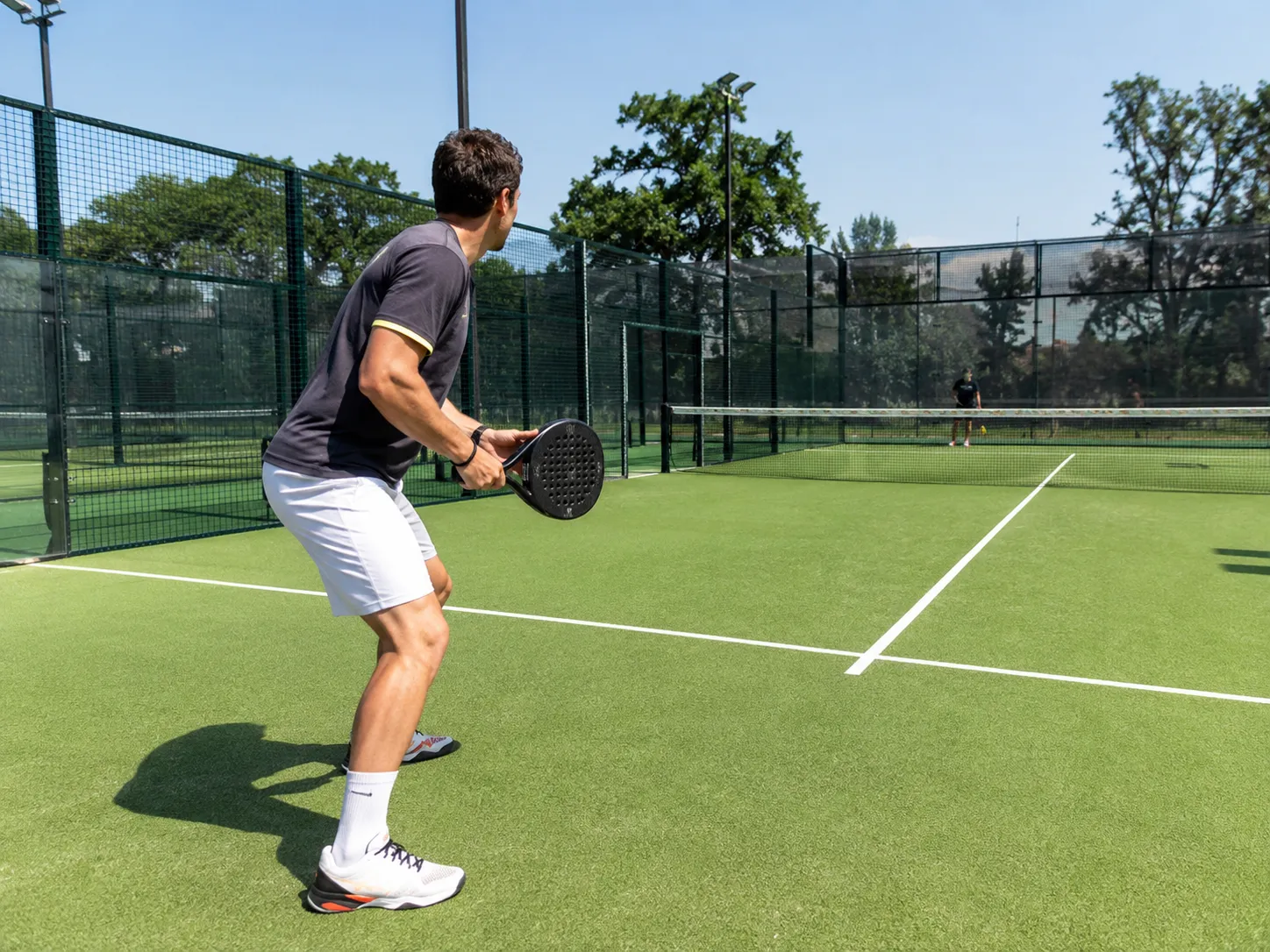
Must-have accessories (without which you should not play)
Three accessories carry the same weight as your racket. Skipping them is one of the classic beginner mistakes in padel and it can cost you — physically and financially.
Padel shoes: safety first
Padel is a sport of multi-directional movement. Quick weight transfers, controlled slides, sudden pivots: a running or fitness shoe offers no lateral support and is the leading cause of ankle sprains on court.
A good padel shoe must combine three characteristics:
- A herringbone sole (“clay”) for grip on sandy synthetic carpet
- Lateral reinforcement to keep the foot stable during sideways movements
- Good cushioning to protect knees, hips and back over the long term
This is your priority investment. Before buying a new grip or a premium bag, make sure you have suitable shoes.
⚠️ Never use tennis shoes on a padel court
Tennis shoe soles are designed for hard courts. On padel’s sandy carpet they provide less grip and can damage the surface. Some clubs refuse court access without appropriate shoes.
The overgrip: your only contact point with the pala
The grip is the original layer applied at the factory to the racket handle. The overgrip is the thin tape you wrap over it. It is your one and only point of contact with the pala during the entire match.
A worn overgrip forces you to squeeze harder to hold the racket. That extra muscle tension travels up the arm and becomes the primary cause of “padel elbow” (lateral epicondylitis). A fresh overgrip allows a relaxed, natural hold.
There are three types:
- Smooth and tacky: maximum stickiness, ideal for players who want direct contact with the pala
- Perforated: for players who sweat heavily, the holes evacuate moisture
- Textured or sandy: a compromise between grip and absorption
A new overgrip costs around €1. For a regular player it needs to be changed every 3 to 5 sessions, as soon as it loses its tackiness. Failing to replace it regularly is a false economy.
The frame protector (bumper): your racket’s life insurance
The bumper is an adhesive strip, usually plastic or carbon, applied to the top edge of the racket. Its job: absorb the inevitable knocks against glass and wire fencing during run-arounds.
Cost: between €3 and €8. Racket it can save: between €100 and €400. Most new rackets come with a factory bumper. Replace it as soon as it is worn rather than waiting for the racket edge to get damaged.
Comfort equipment that makes a real difference
Technical clothing: ditch the cotton
Playing in a cotton t-shirt is a common mistake. Cotton absorbs sweat without drawing it away, becomes heavy as the match goes on and chills the body brutally during breaks.
Technical fabric in polyester or polyamide does the opposite: it transports sweat to the outer surface of the fabric and keeps skin dry. The comfort difference is immediate, especially over a ninety-minute match.
The essentials:
- A lightweight, breathable t-shirt or tank top
- Shorts or a skort with deep pockets for a ball (models with integrated undershorts are particularly practical for women)
- Compression underwear optional but appreciated for long sessions, as it reduces muscle fatigue by improving venous return
Technical socks: the most underrated accessory
The technical sock is probably the most neglected piece of padel kit. Yet it bridges your foot and your shoe throughout the entire match.
A good sports sock needs reinforcement at friction zones (toe, heel, arch) and ankle support to stop it slipping inside the shoe. These details prevent blisters and improve stability during sudden weight shifts. Budget: between €8 and €20 per pair. It is one of the best value-for-prevention items in the whole kit.
Wristbands and a court towel
For players who sweat at the wrists and hands, sweatbands have become essential. They absorb perspiration before it reaches the grip hand and keep the overgrip dry for longer.
A small towel in the bag lets you dry your face and hands during changeovers. It is a detail that matters a great deal in the heat or during long sessions.
The padel bag (paletero): how to choose the right one
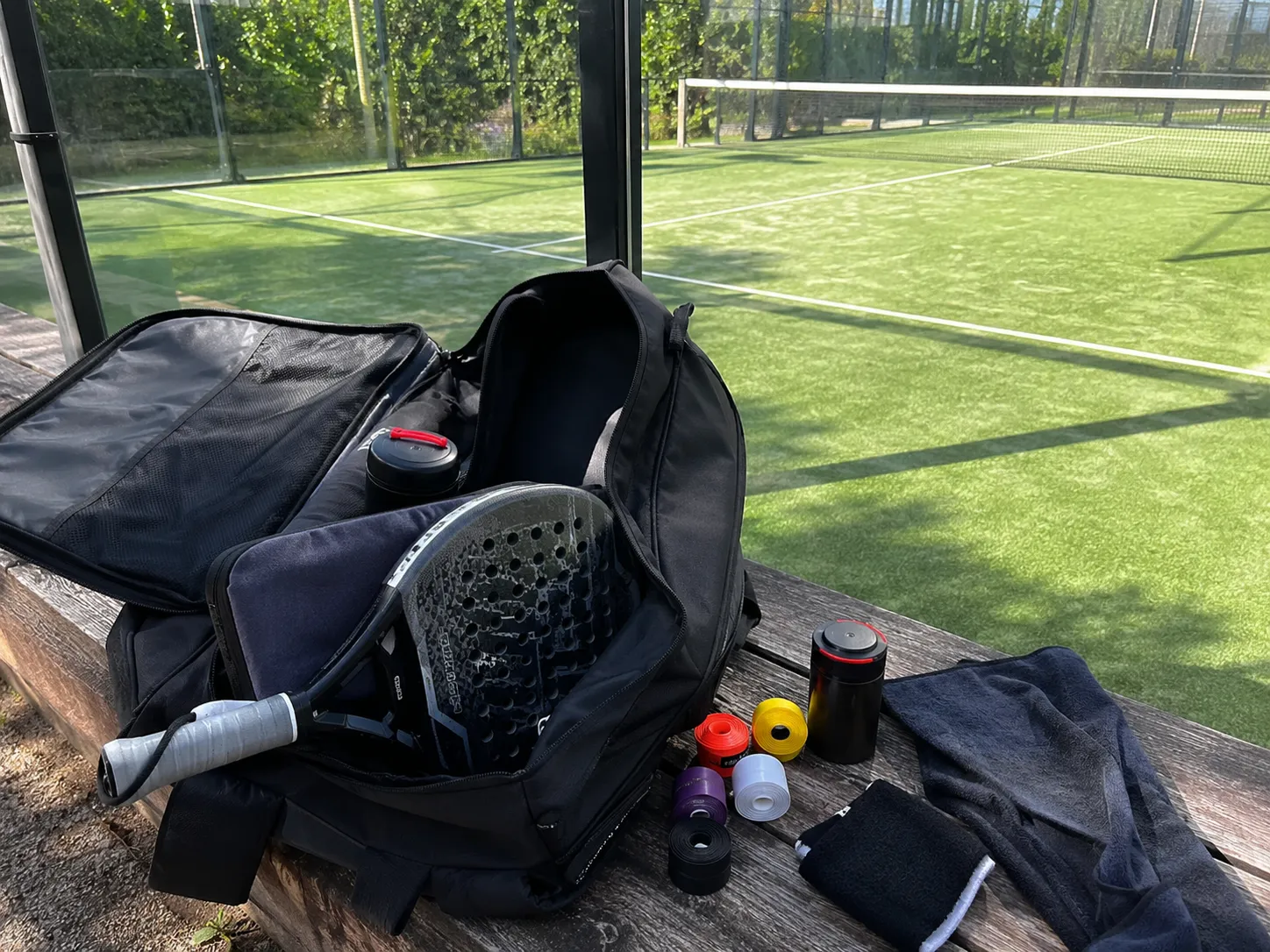
Carrying your racket under your arm or in a generic backpack exposes it to knocks and temperature swings. A dedicated padel bag is not a gadget reserved for enthusiasts — it is direct protection for your investment.
The thermal compartment: the number one criterion
The most important feature of a padel bag is the thermal compartment, also called a “thermo”. This compartment protects the racket from extreme temperature changes.
In summer, a car boot can exceed 60 °C. That heat gradually destroys the foam inside the racket, alters its feel at impact and significantly shortens its lifespan. In winter, thermal shocks crack the composite materials of some palas. A bag without a thermal compartment does not provide this essential protection.
Which size for your playing habit?
The market offers several formats suited to different uses:
- Padel backpack (compact): ideal for players who go straight to the club after work, with one racket and a change of clothes
- Mid-size paletero: the most common format, with 1 to 2 rackets, thermal compartment, ventilated shoe pocket and central compartment for clothing and balls
- Large paletero: for players with several rackets, lots of kit or who travel for tournaments
Whatever the format, make sure the model has a ventilated shoe pocket to separate your used shoes from your clean kit.
Equipment for the tournament organizer
Organizing a padel tournament is a completely different dimension from simply playing. A player only needs their own gear. The organizer must think about full logistics: balls for every court, score management, communication with participants, prizes. With the right equipment, a day that could be stressful becomes smooth and memorable.
The physical essentials for match day
Here is what must be in the organizer’s bag before even thinking about match management:
- Enough balls: plan for 1 to 2 tubes of new balls per court, plus a replacement stock. Never run a tournament with dead balls.
- A charger or power bank: so the phone lasts all day without stress
- A paper backup sheet: a list of players with scores to fill in manually in case of technical failure — it costs nothing and can save a tournament
- Prizes or symbolic trophies: the festive element and recognizing participants keeps them coming back for future sessions
The digital tool that handles everything else
The real headache for the organizer is the draw, rotations, score calculation and live rankings. Done by hand this takes considerable time and produces inevitable errors.
Americano Padel Manager is the app designed precisely to solve this problem. In under 2 minutes, the organizer creates a complete tournament: enter the players’ names (from 4 to 40), select the number of available courts (up to 10) and choose a format from six variants, including Americano Classic, Team or Mixed, and Mexicano Classic, Team or Mixed. The algorithm generates matches with optimal rotation so every player faces and partners a maximum number of different participants.
The ranking updates in real time with each score entry, visible to everyone via a share link. No more laborious spreadsheets, calculation errors and arguments about who scored what.
The app works offline, essential for clubs whose internet connection on court is unreliable. It is available for free on iOS and Android, with a 7-day premium trial, no commitment required.
✓ Tip from an experienced organizer
Share the tournament tracking link in the participants’ WhatsApp group before you start. Players follow their ranking live on their phones and engagement is immediately stronger.
Performance and injury prevention accessories
The ball pressurizer: paid back in two months
The ball pressurizer is an airtight tube or box in which you store balls after playing. The device maintains internal pressure that prevents the balls from losing theirs.
A padel ball gradually loses pressure after the tube is opened, even without being used. A pressurizer multiplies ball lifespan by 3 to 4 times. For a regular player, the investment pays off within a few months.
A technical point that is often overlooked: for the pressure to transfer to the inside of the ball, you need to wait a minimum of 72 hours after pressurizing the balls. And if you do not play for two weeks, recharge the pressurizer because the pressure will have dissipated in the meantime.
Anti-vibration dampers: real prevention or placebo?
Anti-vibration dampers are small silicone devices inserted into the holes on the racket surface. Their promise: reduce vibrations at impact and prevent padel elbow.
Lab tests show a real reduction in vibrations, up to 92% according to some measurements. The medical community remains cautious, however: a damper reduces vibrations but does not cure an existing case of epicondylitis and does not replace a suitable overgrip. In practice, many players feel increased comfort. If you are prone to elbow pain, it is worth trying, but a quality overgrip and good technique remain the first lines of defence.
Cap and protective eyewear: the eye risk that is often ignored
A cap or visor is essential for outdoor play. It prevents glare during lobs and smashes — two situations where tracking the ball often means looking directly towards the sun.
Protective eyewear is a more serious subject than many players realize. A padel ball can reach 100 to 130 km/h at impact. A projectile at that speed hitting the eye can cause irreversible damage up to partial blindness. Eyewear is not yet mandatory at the international federation level, but some Spanish leagues already require it for junior players. For indoor padel, protective sports glasses offer genuine peace of mind, particularly during close net exchanges.
Ankle braces and knee supports: playing long without getting hurt
For players with a history of joint injuries or who play several times a week, joint supports are part of the basic prevention kit.
- A light ankle brace can stabilize a weakened joint without hampering rapid movements
- A compression knee support reduces strain on the knee during repeated flexions and aids recovery
These are not accessories reserved for the injured. Many regular players wear them preventively, especially past the age of 35. And whatever your fitness level, a warm-up routine before every match remains your best protection against injury.
What budget should you plan for?
Beginner: the essential kit (€50 to €100)
To start playing in good conditions without breaking the bank:
| Accessory | Indicative budget |
|---|---|
| Entry-level padel shoes | €40 to €70 |
| Overgrips (pack of 3) | €3 to €5 |
| Bumper (frame protector) | €3 to €8 |
| Technical socks (2 pairs) | €10 to €15 |
Also check out our guide to choosing your padel racket to complete your starter kit.
Regular player: building up gradually (€120 to €200)
Once settled into a regular practice, two to three times a week:
| Accessory | Indicative budget |
|---|---|
| Padel bag with thermal compartment | €40 to €80 |
| Full technical outfit | €40 to €60 |
| Ball pressurizer | €15 to €30 |
| Sweatbands (pack) | €5 to €10 |
| Cap or visor | €15 to €25 |
Competitor: optimal equipment (€250 to €380)
For players who enter tournaments or play intensively at club level:
| Accessory | Indicative budget |
|---|---|
| Premium padel shoes | €80 to €140 |
| Large paletero | €60 to €100 |
| Protective eyewear | €20 to €50 |
| Ankle brace and knee support | €20 to €40 |
| Premium overgrips (stock of 12) | €10 to €15 |
For tournament organizers, the main investment is your time. With Americano Padel Manager, available for free, you can manage up to 40 players on 10 courts at zero cost.
FAQ on padel accessories
What is the difference between a padel grip and an overgrip?
The grip is the original layer applied at the factory to the racket handle. It is thicker and more durable. The overgrip is a thin tape you wrap over it to customize tackiness and slightly adjust handle size. It is the overgrip that you change regularly, every 3 to 5 sessions, not the base grip.
How often should you change your padel overgrip?
As soon as it loses its tackiness and becomes slippery, which corresponds to 3 to 5 sessions for a regular player. A worn overgrip forces you to grip the racket too tightly, fatiguing the arm and encouraging elbow pain. At around €1 per unit, changing it often is one of the best habits you can develop.
Do you really need padel-specific shoes?
Yes. It is the most important accessory after the racket. Running or fitness shoes lack the lateral reinforcement needed for padel’s characteristic movements. Playing without appropriate shoes is the leading cause of ankle sprains. The herringbone sole (“clay”) is the main marker to look for when identifying a shoe suited to the sport.
Is a ball pressurizer really worth it?
Yes, for a player who plays more than once a week. It multiplies ball lifespan by 3 to 4 times and pays for itself quickly. Important point: you need to wait 72 hours after pressurizing the balls for the pressure to actually transfer through the ball wall. If you do not play for 15 days, recharge the pressurizer.
Do anti-vibration dampers really prevent padel elbow?
Anti-vibration dampers measurably reduce vibrations at impact — up to 92% according to some lab tests — but they do not cure an existing case of epicondylitis. They can contribute to prevention, but the primary step is to change your overgrip regularly and work on your striking technique. Persistent elbow pain requires medical attention.
Should you wear protective eyewear for padel?
It is not mandatory under international federation rules, but it is strongly recommended. A padel ball can reach 100 to 130 km/h at impact. A direct hit to the eye can cause irreversible damage. Some Spanish leagues already require it for junior players. For indoor play or net exchanges, protective sports glasses are well worth the cost.
A padel player’s equipment is not limited to the racket. Every accessory has a precise role in your comfort, performance and long-term joint health. Start with the fundamentals, invest progressively in the rest according to your playing frequency and do not neglect prevention.
And if you organize tournaments regularly, the right physical kit combined with a purpose-built app transforms a complicated day to manage into a genuine celebration. Download Americano Padel Manager for free on iOS and Android and create your first tournament in under 2 minutes.