 Americano Padel Manager
 Mastering the Left Side in Padel: Technique, Tactics and Progression
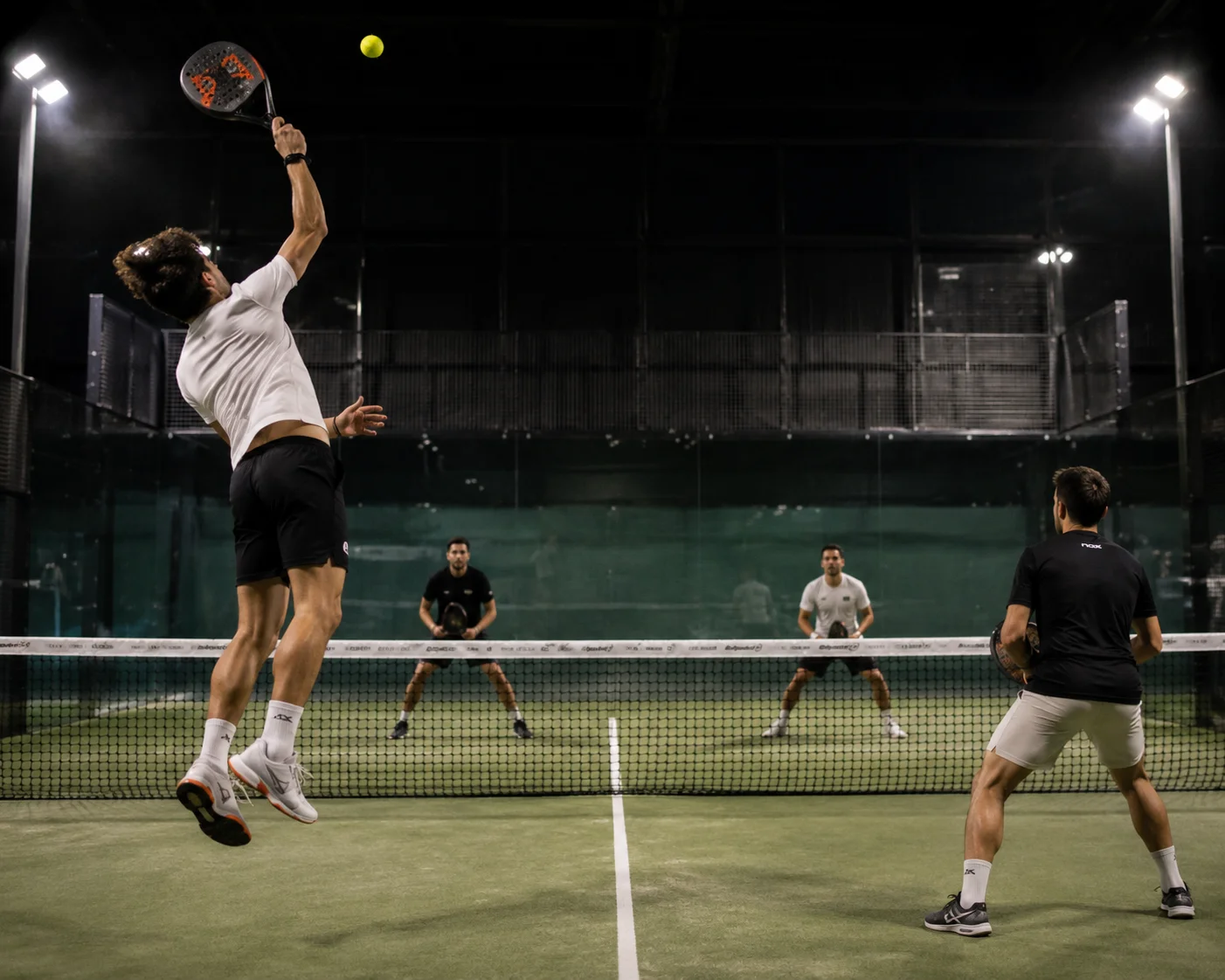
The left side in padel is the attacker’s side, the one who closes out points. Mastering this position requires far more than power: it demands precise technique on overhead shots, sharp game reading and the ability to manage pressure in decisive moments. This guide covers the technical fundamentals, common mistakes to correct and drills to improve as a left-side player.
What Playing on the Left Really Changes About Your Game
Before working on technique, you need to understand why the left side is structurally different from the right side. It is not just a matter of preference.
The 120° Rotation on Deep Lobs
When a deep lob arrives on the left side, a right-handed player must perform a full 120° rotation to end up facing the ball and hit a forehand. Their right-side partner only needs 45°. This asymmetry explains why movement on lobs is far more intense on the left side and why timing is harder to develop.
The Pressure of Decisive Returns
Statistically, the left-side player returns on 6 decisive points per game (set points, advantage, maximum pressure moments) compared to only 2 for the right-side player. This is not a coincidence: it is the very structure of padel that concentrates important returns on the left side. Knowing how to manage this pressure is a skill in its own right.
Can’t Test the Left Side With Your Regular Partner?
That is the most common obstacle. You have a regular partner who has occupied the left side forever, habits are entrenched, and renegotiating positions mid-match creates unnecessary friction.
The solution is simple: play sessions in Americano format. In this format, you change partner every match. Over a ninety-minute session, you play with 4 or 5 different partners, giving you multiple opportunities to take the left side in varied contexts, without relational pressure and against different opponent profiles. It is the best laboratory for testing and consolidating your left-side game.
Americano Padel Manager is the app that handles this organisation automatically. In under 2 minutes, you enter the players and the app generates the rotations, court assignments and live rankings. All you have to do is play. It works for any number of players, from 4 to several dozen, and operates entirely offline.
The Left-Side Player’s Technical Arsenal
This is where most players stagnate: they know the shot names, but not their precise mechanics. Here is what separates an effective vibora from one that floats.
The Vibora: The Shot That Pins the Ball to the Glass
The vibora is not a powerful smash. It is a shot played at 60-70% power, whose effectiveness rests entirely on lateral spin. The goal: to make the ball die against the side glass after the bounce, at an angle that is difficult to retrieve.
Essential technical points:
- Continental grip is mandatory. A forehand grip prevents you from generating the necessary lateral spin.
- Contact point at 3 o’clock on the ball: strike the outside edge of the ball, not underneath or on top.
- Wrist snap at impact: this “lateral brushing” motion creates the spin. However, shoulder rotation and the racket path (from back to front, slightly outside-in) generate most of the rotation, not the wrist alone.
- No wide swing: a vibora with a big arm motion floats. The movement must remain short and controlled, with a follow-through that crosses the body.
The vibora is used when you are well positioned, at mid-distance from the back wall. If the lob is deep and you are off-balance, switch to the bandeja.
The Smash por Tres: Technique and Timing
The smash por tres (remate por 3) aims to send the ball out over the 3-metre side fence. It is the finisher’s signature shot, and its execution is more precise than it looks.
The swing must be triggered early, when the ball starts to drop to shoulder height. Hitting too early sends the ball into the glass rather than out. Hitting too late reduces the available angle. Hip and shoulder rotation generate the speed: do not try to compensate with the arm alone.
The target direction is not the opponent’s baseline but the 3-metre fence on the diagonal. If the ball lands on the back glass, the opponent can retrieve it. If it clears the fence, the point is over.
The Bajada de Pared: The Most Underrated Shot
The bajada de pared is the offensive shot you play when the opponent’s lob was deep, bounced on the floor then on the back glass, and the ball comes back at waist height or higher. It is your chance to retake the initiative without chasing the ball.
Body position is key: your body must be between the ball and the glass. If you are too close to the wall, you do not have enough space to strike. Wait until the ball has completely separated from the wall before triggering the shot. Hitting too early when it is still “hugging” the wall produces a mishire or a mishit.
The strike is made from high to low, with contact at the maximum height to benefit from the best attack angle towards the opponent.
The Attacking Bandeja vs the Neutralising Bandeja
Many players use only one bandeja for every situation. The distinction is fundamental.
The neutralising bandeja is flat, with little spin, and serves to keep the pair in high position on a difficult lob. The attacking bandeja is played with more spin and depth, often cross-court, to put the opponent under pressure on their return. On the left side, this second variant must become a regular tool: it creates openings without exposing you the way a missed smash would.
Positioning and Game Reading
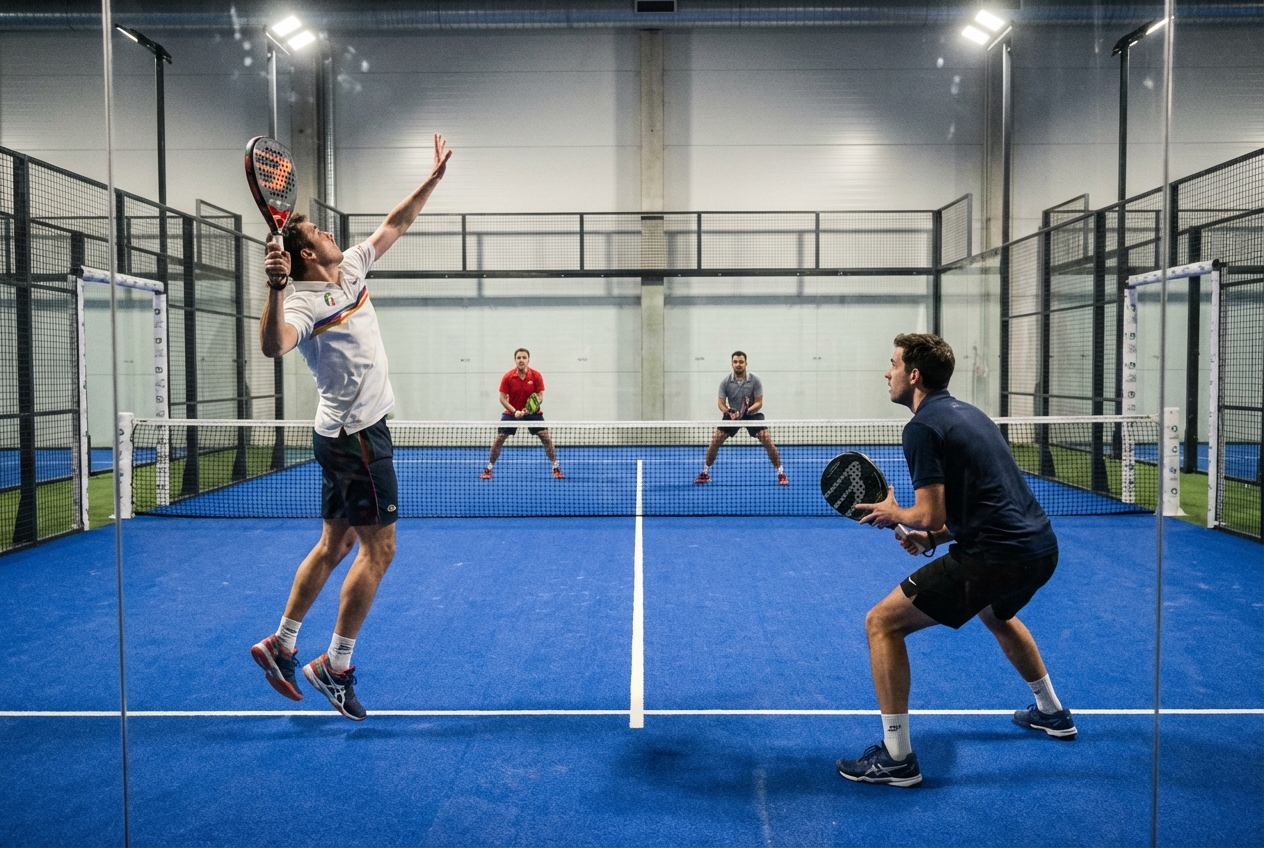
A good left-side player does not just hit hard. They know where to be and when to move.
Offensive Zone and Defensive Zone
In high position at the net, your natural base is slightly left of centre, allowing you to cover both the diagonal and the left corridor. After each overhead shot, return to this position: a quarter of the following balls will arrive there.
In defence, in low position at the baseline, place yourself about one metre left of centre. Your forehand covers the central axis, your backhand handles the corridor.
Intercepting in the Centre Without Disrupting the Pair
Intercepting in the centre is one of the great strengths of the left-side player. When a high, central ball arrives within forehand range, it is your ball. But intercepting it means moving towards the middle, temporarily opening your left corridor.
The rule: only take the central ball if you can finish the point or create real pressure. If your position does not allow you to strike cleanly, let your partner handle it and stay to cover your corridor. A missed interception costs the point.
The 5 Most Common Mistakes on the Left Side
-
Smashing every high ball regardless of height or depth. On a deep, fast lob, you are off-balance. The bandeja is the right decision. Save the smash for floating, well-placed lobs.
-
Leaving the centre open after an overhead shot. After a vibora or bandeja that has pulled you towards the glass, many players are slow to return to position. Opponents exploit this central corridor immediately.
-
A flat vibora with no spin. A vibora without rotation is just a slow ball. If you are not generating lateral spin through the continental grip and brushing action, switch to the bandeja, which will at least be controlled.
-
Too many straight-line put-aways. The forehand down the line is a surprise weapon, not a repeated pattern. If you use it systematically, opponents adapt within two games.
-
Staying passive at the net. The left-side player must exert constant pressure on opponents from the net. Stepping back or playing defensively from the high position gives opponents time and breaks the cohesion with your partner.
3 Drills to Improve Specifically on the Left Side
Drill 1: The Overhead Basket
A partner feeds you high balls from the other side of the net, across the full width of the left corridor, varying the depth. Your only objective: choose the right shot (smash, vibora, bandeja, bajada) based on the incoming trajectory, not based on preference. This drill forces ball reading and decision-making before mechanics.
Drill 2: Advance and Retreat Under Pressure
You start at the baseline on the left side. A partner sends a lob. You play your overhead shot from mid-court or the high position, then immediately retreat to the baseline if the ball comes back. Chain 10 repetitions without a pause. This sequence simulates what actually happens in a match: the left side advances and retreats far more than the right side.
Drill 3: The Bajada in a Match-Play Position
Your partner plays a deep lob, deliberately so that the ball comes back off the back glass. Your mission: position yourself correctly between the ball and the wall, wait for the peak of the bounce, and strike offensively towards the opponent’s centre. Start slowly to validate your body position, then increase the pace.
Frequently Asked Questions
Do you need to be powerful to play on the left side in padel?
Power is an asset, not a prerequisite. An effective left-side player can succeed through precise technique and good game reading. The vibora, for example, relies on lateral spin, not brute force. That said, the ability to generate explosiveness on smashes and sustain an intense game rhythm is essential in the long run.
What is the difference between a vibora and a bandeja in padel?
The vibora is an offensive shot with strong lateral spin, designed to pin the ball against the side glass. The bandeja is a control shot, flatter, that allows you to maintain the high position without taking risks. The bandeja is played when you are off-balance or the lob is too deep to attack. The vibora is used when you are well positioned and want to put the opponent under pressure.
How do you choose between a smash and a vibora depending on the situation?
Look at the lob’s trajectory. If the lob is short and floating, the smash por tres is the right option: you can hit at full speed with the necessary angle. If the lob is at medium height but you are well positioned, the vibora is safer and creates more difficulty for the opponent on the bounce. If the lob is deep or you are short on time, play a bandeja to keep the high position.
Can a beginner specialise on the left side?
It is better to start on the right side. The game is less fast there, the pressure on decisive points is lower, and you can develop your foundations without being subjected to the physical demands of the left side. After a few months of regular practice, gradually test the left side, particularly in Americano sessions where you change partner.
What exactly is the bajada de pared?
The bajada de pared (wall descent) is the offensive shot you play when the ball comes back off the back glass at waist height or higher. It is an opportunity to retake the attack without chasing the ball. Execution requires positioning yourself between the ball and the wall, waiting for the ball to completely separate from the glass, then striking from high to low at the maximum possible height.
Want to test these techniques in a real match situation? Organise an Americano session with your regular partners. Download Americano Padel Manager for free on iOS and Android, enter your players and let the app manage the rotations. Every match is a new opportunity to consolidate your left-side game. To go further, check out our guide on essential padel shots and our warm-up routine before each session.