 Americano Padel Manager
 How to Choose a Padel Racket: The Complete Buying Guide
Choosing a padel racket comes down to four key criteria: the shape, the weight, the materials, and your skill level. A round racket offers control and forgiveness, a teardrop brings versatility, and a diamond maximizes power. Here is everything you need to know to make the right choice in 2026.
Padel is one of the fastest-growing sports in Europe, and equipment plays a key role in your progression. Unlike tennis, the padel racket (also called pala) has no strings: it is a solid surface with drilled holes, whose composition and shape directly influence your game. Whether you are just starting out or have been playing for years, this guide helps you find the racket that matches your profile.
Racket Shape: The First Criterion to Consider
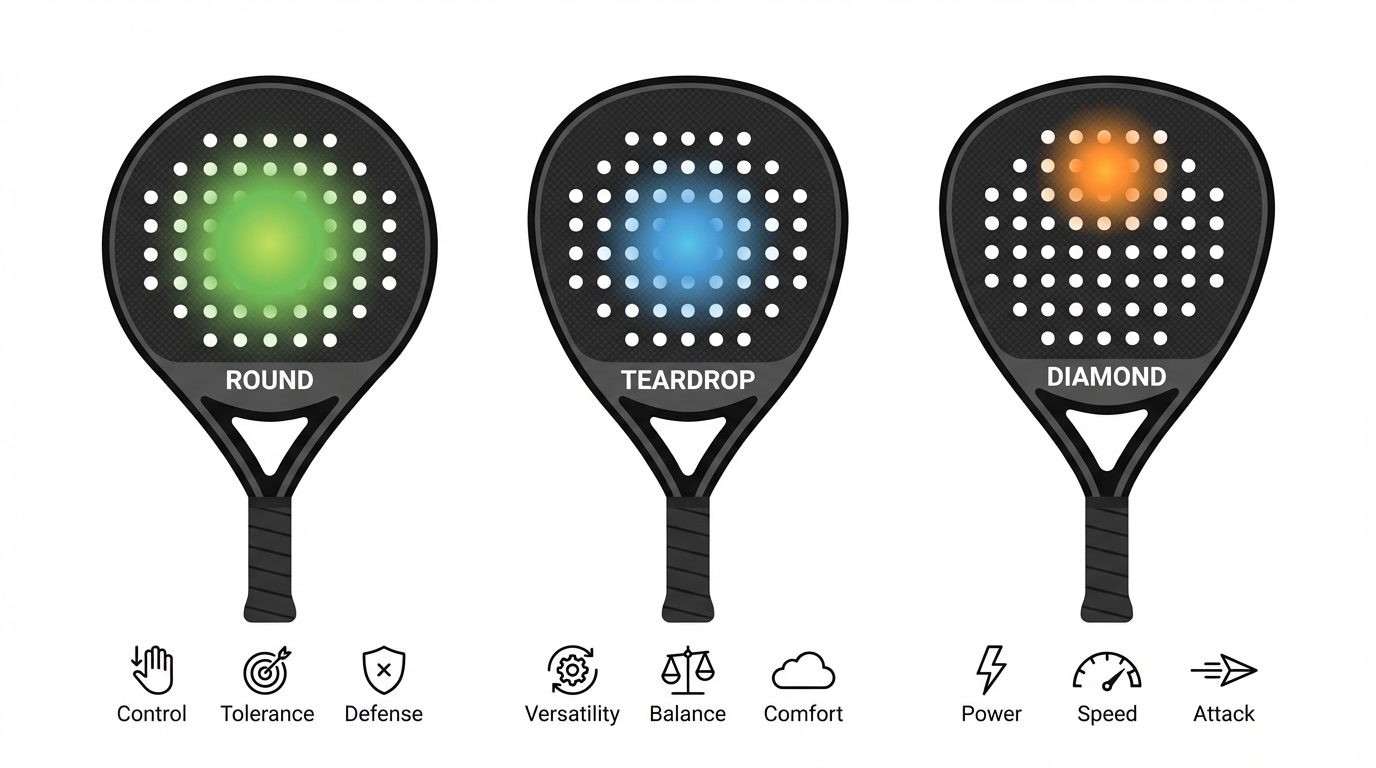
The shape of your racket determines the location of the sweet spot and, consequently, your playing style. This is the first decision to make before even looking at weight or materials.
Round Racket: Control and Forgiveness
The round racket concentrates weight in the handle and offers a large, centered sweet spot. The result: off-center hits are forgiven, control is excellent, and maneuverability at the net is optimal.
This shape is recommended for:
- Beginners building their technique
- Net players who prioritize volleys and precision
- Those who want to reduce vibrations and protect their joints
✓ Key advantage
The large sweet spot of the round racket forgives centering errors, a considerable advantage when learning padel strokes.
Teardrop Racket: Versatility
The teardrop shape is a compromise between control and power. The sweet spot is slightly shifted upward compared to the round, which adds more punch on offensive shots while maintaining good forgiveness.
It is the most sold shape worldwide, and for good reason: it suits the vast majority of players, from confirmed beginners to advanced intermediates.
Diamond Racket: Power Above All
The diamond racket concentrates weight in the head. It produces a lever effect (or “hammer effect”) that generates maximum power on smashes and bandejas.
The downside: the sweet spot is smaller and located at the top of the racket. Off-center hits are less forgiving, and the head-heavy weight puts more strain on the elbow and wrist.
⚠️ Warning
The diamond racket is reserved for advanced players with solid technique. Used too early, it can slow your progression and increase the risk of epicondylitis (tennis elbow).
Weight and Balance: Finding the Right Equilibrium
Weight and balance are two distinct criteria that directly influence the comfort and power of your racket.
What Weight to Choose Based on Your Profile
The average weight of a padel racket falls between 350 g and 380 g. The 2026 trend is toward lighter rackets to preserve player health.
- Women and juniors: 345 g to 365 g
- Beginner/intermediate men: 355 g to 370 g
- Advanced men: 365 g to 380 g
A racket that is too heavy tires the arm and slows your reflexes at the net. A racket that is too light lacks stability against powerful shots from your opponent.
Low, Neutral, or High Balance: Impact on Play
The balance indicates where the center of gravity of the racket is located:
- Low balance (< 265 mm): weight in the handle. Maximum maneuverability, ideal for quick volleys and defensive play
- Neutral balance (~270 mm): balanced compromise for an all-round game
- High balance (> 275 mm): weight in the head. Increased power on smashes, but more demanding on the wrist
For beginners and intermediates, a low to neutral balance is preferable. High balance suits confirmed players who already master their technique.
Materials and Foam: What Actually Changes the Feel
Beneath the similar appearance of two rackets, materials make all the difference in terms of feel, power, and durability.
Fiberglass or Carbon: The Right Choice for Your Level
Fiberglass is the most common material on entry-level and mid-range rackets. It offers:
- Flexibility that absorbs vibrations
- A trampoline effect that propels the ball effortlessly
- Ideal forgiveness for players who are still learning
Carbon is stiffer and offers surgical precision. It comes in different weave densities:
- 3K: light weave, more flexible
- 12K: standard for intermediate rackets
- 18K and 24K: dense weave, maximum rigidity, reserved for advanced players
The 2026 trend is toward hybrid structures: carbon on the faces for precision, fiberglass on the frame to absorb vibrations. The best of both worlds.
FOAM, EVA, or Hybrid Core: The Underrated Criterion
The foam (or rubber) inside the racket is often overlooked by buyers. Yet it radically changes the ball feel.
- FOAM core: soft and elastic. Excellent control in defense, good ball exit on slow shots. Ideal for players who prioritize touch
- EVA core: harder and more compact. Controlled power on explosive shots, better durability. The choice of offensive players
- Hybrid core: FOAM center with EVA edges. It combines softness at the center for touch and rigidity on the edges for power
✓ Tip
If you are unsure between FOAM and EVA, test both in a shop or by borrowing a partner’s racket. The difference in feel is noticeable from the very first shots.
Which Padel Racket to Choose Based on Your Level
Beginner: Prioritize Comfort and Forgiveness
When starting out, the priority is to develop your technique without being held back by unsuitable equipment. Here are the characteristics to look for:
- Round shape for a large sweet spot
- Light weight (350-360 g) for maneuverability
- Fiberglass for forgiveness
- Low balance for control at the net
Do not fall into the trap of a high-end racket: a beginner progresses quickly and will change rackets after 6 to 12 months of practice. Investing €60 to €120 is more than enough for this phase.
Intermediate: Increase Power Without Losing Control
You master the basic shots and are starting to vary your play? It is time to move to a racket that supports your progression:
- Teardrop shape to gain power while keeping control
- Medium weight (360-375 g)
- Carbon 3K or 12K mixed with fiberglass
- Neutral balance for an all-round game
This is the richest segment in terms of choices. A budget of €100 to €200 gives access to excellent rackets.
Advanced: Optimize Every Aspect of Your Game
Advanced players know their playing style and what they are looking for. At this level, the racket choice is based on your strengths:
- Baseline player: diamond or high teardrop shape, carbon 12K+, EVA foam
- Net player: round or low teardrop shape, low balance, FOAM core
- All-round player: classic teardrop, hybrid carbon, hybrid foam

Organize a Tournament with the Right Racket Using Americano Padel Manager
Choosing the right racket is even more important when you play in tournaments. In the Americano format, you change partners every match: your racket needs to be versatile enough to adapt to different playing styles. A teardrop with neutral balance is often the wisest choice for this type of competition.
Americano Padel Manager lets you create a complete tournament in under 2 minutes. The app automatically generates the optimal player rotation, manages the live leaderboard, and adapts from 4 to 40 participants across multiple courts. Whether you are organizing a session among friends or a club event, APM handles all the logistics so you can focus on your game.
The app also offers Classic, Mixed, and Team Americano formats as well as Mexicano with matches based on the live leaderboard. Free and available on iOS and Android, it is used by thousands of clubs in over 75 countries.
What Budget for a Padel Racket
Price Ranges by Level
| Level | Recommended Budget | What to Expect |
|---|---|---|
| Beginner | €60 to €120 | Fiberglass, round shape, FOAM core |
| Intermediate | €100 to €200 | Carbon/fiberglass mix, teardrop, EVA or hybrid core |
| Advanced | €180 to €350 | High-density carbon, cutting-edge technology, signature models |
Should You Buy Expensive When Starting Out
No. A €300 racket will not make you progress faster than an €80 racket. On the contrary, high-end rackets are often designed for players who already have the technique to make the most of them.
A beginner benefits most from a forgiving, lightweight racket. The money saved is better invested in padel lessons or proper shoes (grip and ankle support matter as much as the racket).
Mistakes to Avoid When Choosing Your Racket
- Copying a pro’s racket: professional players use rackets tailored to their physique and technique. What works for Agustin Tapia will not necessarily work for you
- Skipping the test: always try a racket before buying. A 30-minute trial is worth more than any online comparison
- Choosing based on design alone: brands invest in aesthetics, but it is the internal composition that counts
- Ignoring pain: if you feel pain in your elbow or wrist, your racket is probably too heavy, too stiff, or has too high a balance
- Never changing: your level evolves, and your racket should follow. Reassess your choice every 12 to 18 months
Frequently Asked Questions
What padel racket should I choose as a beginner?
Go for a round-shaped racket, lightweight (350-360 g), made of fiberglass with a low balance. This type of racket offers a large sweet spot and good forgiveness for centering errors. Recommended budget: €60 to €120. Do not over-invest, as you will likely change rackets after a few months of progression.
What is the difference between a round and a diamond racket?
The round racket concentrates weight in the handle with a large, centered sweet spot: it offers control and forgiveness. The diamond racket concentrates weight in the head with a smaller, higher sweet spot: it offers maximum power but forgives fewer errors. The round suits beginners and net players, while the diamond suits advanced players who master their technique.
What budget should I plan for a good padel racket?
Between €60 and €120 for a beginner, €100 to €200 for an intermediate, and €180 to €350 for an advanced player. Price does not always equal quality for your level: an €80 racket well suited to your profile will perform better than a €300 racket designed for a different type of player.
How do I know if a racket is too heavy for me?
If you experience early fatigue in your forearm, pain in your elbow or wrist after a session, or if your reflexes at the net decrease toward the end of a match, your racket is probably too heavy. Try a model 10 to 15 g lighter and compare how it feels.
Should I change rackets as I improve?
Yes. Your first beginner racket will only last 6 to 12 months. As your technique improves, you will need more responsiveness: a more offensive shape, more precise materials, and a foam better suited to your style. Reassess your equipment every 12 to 18 months.
Found the perfect racket? It is time to test it in real conditions. Download Americano Padel Manager for free on iOS and Android to organize your next tournament in under 2 minutes, with automatic player rotation and live leaderboard.