 Americano Padel Manager
Team americano padel: the fixed pairs format
Team americano is the variant of the americano where you keep the same partner from start to finish. You sign up as a pair, every team faces every other team, and the final standings crown a team rather than a player. The scoring itself does not change: a rally won is worth one point, and the match stops at a fixed total of 16, 24 or 32 points.
This is the format people look for as soon as they play with the same partner regularly, and the one tournament tools often leave out, because most of them assume partners rotate. Here is how it works, and when to pick it over a classic americano.

What is a team americano?
The classic americano rests on a simple idea: you play with everyone, and you score for yourself alone. Team americano keeps the first principle, playing against everyone, and drops the second.
You enter as a pair
The unit of the tournament is no longer the player, it is the team. You choose your partner before the tournament, and that pair never changes. What rotates is the opposition: your team takes on each of the other teams in turn.
In practice, a six team tournament means each pair plays five matches, one against each of the others. It is a classic round robin, applied to pairs rather than individual players.
The scoring stays the same
The scale is the one used in every americano format. Each rally won is worth 1 point, and the match ends once both teams together have reached the agreed total, usually 16, 24 or 32 points.
On a 24 point match finished 15 to 9, the winning team banks 15 points and the losing team 9. Both players on a team record the same score, which makes sense since they stay together for the whole session. The full scoring scale is identical to the one described in our guide to the americano score.
The standings are team standings
At the end of the tournament, it is each team’s point total that decides the winner. Since both teammates collect exactly the same points, the individual standings and the team standings tell the same story.
That is a fundamental difference with the classic americano, where two players from the same match can finish at opposite ends of the table depending on the quality of the partners they were handed.
What it changes for the players
Team americano does not simply freeze the pairs, it changes the nature of the evening.
You build something. In a classic americano, every match starts from scratch with a new partner: there is no time to divide up the court. With fixed teams, you fix your positioning match after match, you learn who goes to the net and who covers the lob, and the pair genuinely improves over the session.
The result is yours. Finishing first in a classic americano depends partly on the partners you were given. In a team americano, the performance belongs entirely to your pair, which makes a win feel sharper and a loss more instructive.
Luck matters less. The format rewards consistency across the whole session. A bad match cannot be rescued by a providential partner in the next round.
The trade off. You meet fewer people. If your goal is to widen your circle of partners or bring new members into the club, the classic americano remains the better fit.
Running a team americano with Americano Padel Manager
Few tools handle this format natively, because it requires thinking in teams rather than players at every stage, from entering the participants right through to the final standings.
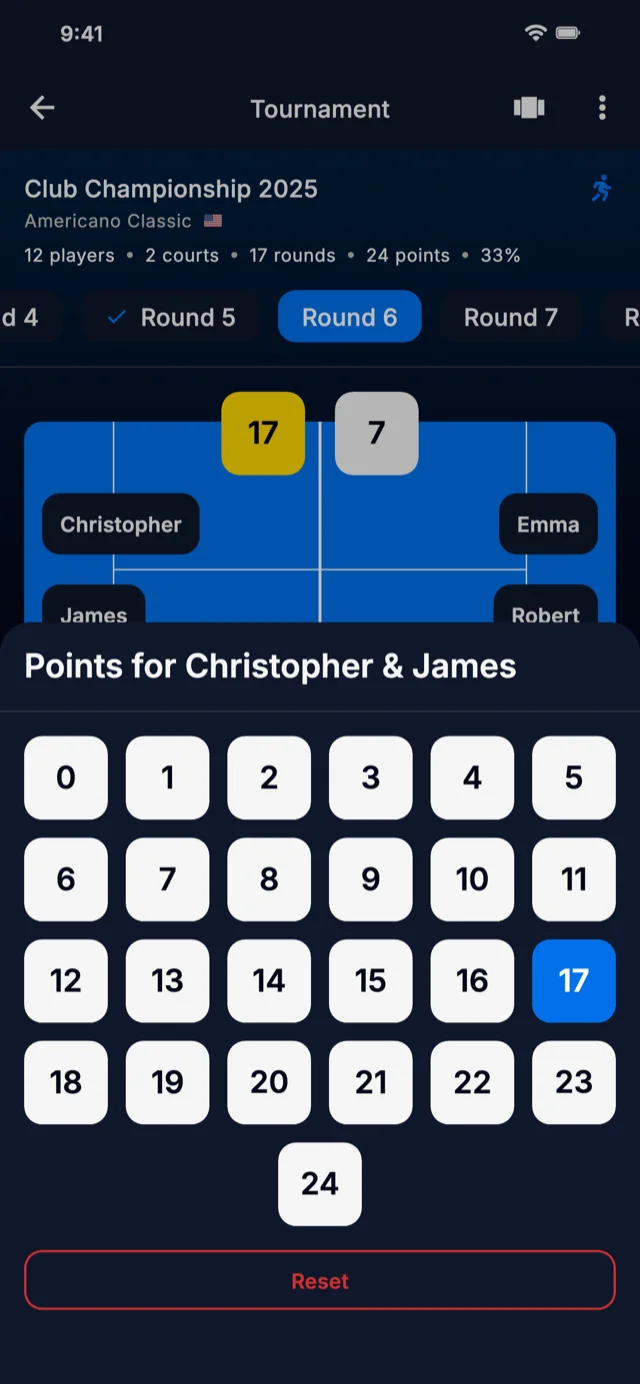
In Americano Padel Manager, team is a variant in its own right, available when you pick the format. You enter teams rather than players, and the app builds the rotation that brings every pair up against every other, spreading the matches across however many courts you have.
The rest of the flow is identical to the other formats: you enter the score of each match, the standings update live, and every participant can follow them on their phone during the session. The app handles up to 10 simultaneous courts and works offline, which solves the problem of clubs with no signal courtside.
The format also exists as a mexicano team, where the teams stay fixed but the fixtures are built from the live standings rather than from a rotation planned in advance. The best teams of the moment end up on court 1, and the matches tighten up as the session goes on.
Team, classic or mixed: how to choose
The three americano variants answer different intentions. Here is how to decide.
| Partner | Standings | Who it suits | |
|---|---|---|---|
| Classic | Changes every match | Individual | Meeting people, mixing levels |
| Mixed | Changes, one woman and one man per pair | Individual | Balanced mixed sessions |
| Team | Fixed for the whole session | By team | Regular pairs, competitive spirit |
Choose team if your players already come in twos, if your group enjoys team competition, or if you are running an event where the pairs represent something, such as a corporate tournament between departments or a match between clubs.
Choose classic if your goal is social, if levels vary widely, or if you are welcoming new players you want to move around the group. Our guide to the americano rules covers how that works.
Choose mixed if you want to guarantee one woman and one man in every pair, which our mixed americano guide explains in detail.
✓ The simplest test
Ask yourself whether your players sign up alone or in twos. Individual entries call for a classic or mixed americano. Entries by pair call for a team.
How many teams and courts
Sizing a team americano follows a clearer rule than the individual formats, since the basic unit is the pair.
The number of teams. Every team has to face all the others, so the number of matches per team equals the number of teams minus one. Four teams means three matches per pair, six teams means five, eight teams means seven. Beyond eight teams the session gets seriously long, and it becomes worth splitting into two groups or shortening the matches.
The number of courts. Two teams occupy a court, so one court absorbs two teams per match. With six teams, three courts let everyone play at the same time. With only two courts, one team in three sits out each match, and the rotation has to spread those breaks fairly rather than always penalising the same people.
The duration. Count the length of one match multiplied by the number of matches, plus a few minutes of turnaround between each. Matches to 24 points last roughly 12 minutes, so six teams on three courts fit into a session of about an hour and a quarter. Our article on how many players for an americano gives the same benchmarks for the individual formats.
An odd number of teams. With five or seven teams, one team rests each match. That works perfectly well, provided the breaks rotate properly from one match to the next.
Frequently asked questions about team americano
What is the difference between a classic americano and a team americano?
In a classic americano, you change partner every match and the final standings are individual. In a team americano, you keep the same partner from start to finish, and it is the team that is ranked. The scoring is identical in both cases: a rally won is worth one point, and the match stops at a fixed total.
How many teams do you need for a team americano?
Four teams minimum for the format to make sense, which gives three matches per pair. Six to eight teams is the most comfortable range. Beyond that the number of matches gets high, and you are better off making two groups or shortening the match format.
Can you play a team americano with an odd number of teams?
Yes. With five or seven teams, one pair rests each match while the others play. What matters is that those breaks are spread evenly across the whole session, so that no team sits out twice while the others sit out only once.
Are team americano standings individual or by team?
By team. Both players in a pair collect exactly the same points, since they play all their matches together. Individual standings still exist, but they simply mirror the team standings, with two players from the same pair always level.
Can you change partner during a team americano?
No, that is the very principle of the format. The rotation is built so that each team faces all the others, and changing a pair halfway through would make the standings incomparable. If a player has to leave, club practice is to replace them with someone of a similar level so the team can finish its matches.
What is the difference between team americano and mexicano team?
Both keep the teams fixed. The difference is how the fixtures are put together. In team americano, the rotation is worked out in advance so that every team meets every other. In mexicano team, each round is built from the current standings, which puts the best teams on court 1 and tightens the matches as the session goes on.
Team americano answers a simple need that the individual formats do not cover: playing with the person you actually want to play with, for the whole session, without giving up on facing everyone. It is the format of regular pairs, corporate tournaments and club versus club meetings.
Americano Padel Manager handles it natively, in Americano as well as Mexicano, with team entry, automatic rotation and live standings. The app is rated 4.9 out of 5 and used in more than 75 countries, with a free download on iPhone and Android and a 7 day premium trial.