 Americano Padel Manager
Which americano padel app should you choose?
Remember five criteria: the quality of the rotations, the formats covered, the flexibility on player and court numbers, what the players actually see, and how transparent the paid model is. The first one matters far more than the rest, and it is the one almost nobody checks before committing.
There are dozens of tools today for running an americano, from a spreadsheet file to an online generator to a mobile app. Rather than drawing up a ranking that will be out of date in six months, here is the method for choosing with your eyes open, and what we offer on our side.

The three families of solutions
Before comparing tools one by one, you need to know which family you are shopping in. Each one has its own logic, and the right choice depends above all on how often you organise.
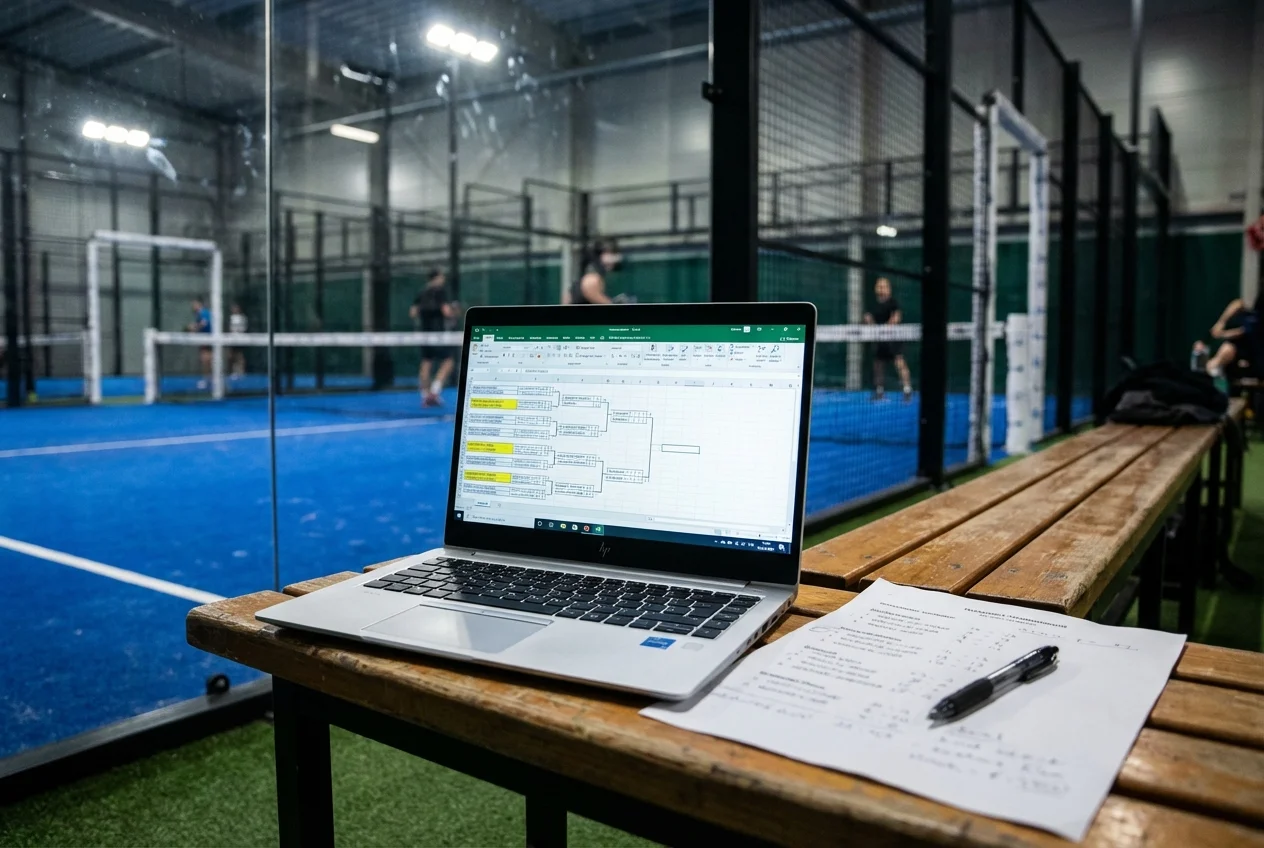
The spreadsheet or the paper sheet
This is where everyone starts. You download a template, fill in the names, and copy out rotations that were worked out in advance.
What it gives you: nothing to install, nothing to pay, and total control over what is displayed. For an eight player americano on one court, it is perfectly adequate.
Where it breaks down: the rotation is fixed. If a player does not show up, if you go from twelve to eleven participants, or if you add a second court, the whole sheet has to be redone. The maths is done by hand, so ranking errors happen, and they always happen at the end, when everyone is waiting for the result. Our detailed comparison of a spreadsheet template and an app puts a number on what that costs in real time.
The online generator
A web page where you enter a number of players and which spits out a match grid, sometimes with score tracking.
What it gives you: nothing to install either, instant access from any browser, and automatic generation that already rules out rotation mistakes.
Where it breaks down: the connection. Plenty of clubs have temperamental wifi, or no wifi at all in the court area, and a web generator becomes unusable at the exact moment you need it. Persistence also varies: depending on the tool, closing the tab can be enough to lose the tournament in progress.
The dedicated mobile app
Software installed on the organiser’s phone that handles creation, the running order, the scores and the leaderboard.
What it gives you: it works without a connection, it saves tournaments, it handles several courts and it updates the leaderboard live. This is the family that copes best with the surprises of a real session.
Where it breaks down: you have to install something, and most of these apps run on a paid model beyond a certain level of use. Which is why the last criterion on our list matters so much.
The five criteria that really separate tools
Once you have picked the family, here is what to look at. These criteria apply to any tool, ours included.
1. The quality of the rotations
This is the decisive criterion, and paradoxically the one nobody talks about. Two apps can advertise exactly the same formats and produce tournaments of wildly different quality.
A tournament generator has to solve a problem that is anything but obvious: getting every participant to play with as many different partners as possible, against as many different opponents as possible, while balancing playing and waiting time, and while filling every available court in every round. Those goals contradict each other, and plenty of tools settle for a rough approximation.
The symptoms show up on the very first evening:
- unbalanced waiting, where the same players sit down three times while others never stop
- empty courts in some rounds, even though the club booked them and players are waiting
- repeated partners early in the tournament while other pairings never happen at all
The test is simple: create a trial tournament with your real numbers and look, before anyone even plays, at how many matches each person gets, how many times each person sits out, and whether every court is used in every round. It takes seconds to find out whether the tool holds up.
2. The formats actually covered
“Americano” does not mean the same thing everywhere. Check that the tool handles the variant you need:
- the classic americano, where partners change every round
- the mixed americano, with one woman and one man per pair
- the team americano, where the pairs stay fixed
- the mexicano, where matches are built from the live leaderboard
A club running a mixed evening on Friday and a mexicano on Tuesday needs all four. A settled group of friends may never need anything but the first.
3. Flexibility on players and courts
Two questions are enough:
Does it work with a player count that is not a multiple of four? In real life you will often be 9, 11 or 13. A good tool handles those numbers and, above all, spreads the byes fairly across everyone instead of always sitting the same people down.
Does it handle several courts? As soon as you book two courts, the tool has to spread the matches across them and keep the rounds in sync. Many free solutions stop at a single court.
4. What the players see
A tournament where only the organiser can see the leaderboard is a tournament where the organiser spends the evening answering “where am I?” and “who am I playing with next round?”.
So the question to ask is not only “can I share a link?”, but “what can each player do from their own phone?”. Three levels exist, and the gap between them is considerable:
- Nothing. The organiser calls the matches out loud and keeps the leaderboard to themselves.
- Viewing. A link or a display on a club TV lets people follow the scores, but you have to walk over or stay in front of the screen.
- Taking part. Every player joins the tournament from their phone, sees their next match and the live leaderboard, and the organiser can hand score entry over to other participants.
That third level changes the evening. The organiser stops being the bottleneck everything has to pass through, and everyone becomes self sufficient. Check exactly what your tool offers on this point, because this is where the differences are widest.
As for the connection, the subject is often overrated: serious tools cope perfectly well with mediocre club wifi or patchy 4G through the glass. It is no longer a deciding criterion in itself, simply basic hygiene.
5. Transparency of the paid model
The awkward point, and the one to watch most closely. Plenty of tools present themselves as free and reveal their limit at the worst possible moment: when you add the ninth player, or the second court, in front of twenty people who are waiting.
The right question is not “is it free?” but “what is free, and where is the limit?”. A tool that states its boundary clearly is better than a tool that hides it behind a button.
Our answer: Americano Padel Manager
We may as well say it plainly, Americano Padel Manager is our app. So you will not be reading a ranking here in which we happen to come first. Here instead is why it exists, and how it stands on the five criteria above.
Why we built it
It came out of a player’s frustration, not a market study. Before writing it, we tested a great many americano padel apps, and the finding was almost always the same: the rotations are handled badly.
Unoptimised tournaments, waiting times that swing wildly from one player to the next, and in some cases courts left empty in certain rounds even though the club booked them and players are sitting at the side. Over a two hour evening, those flaws are paid for in matches lost by everybody.
That is the problem we attacked first. Match generation runs on an optimisation engine that looks for the best possible combination for whatever configuration you ask for: any number of players, any number of courts, including the awkward headcounts that other tools handle poorly. The goal is met on all three fronts at once, namely variety of partners and opponents, balanced waiting time, and every court occupied in every round.
Where it stands on the five criteria
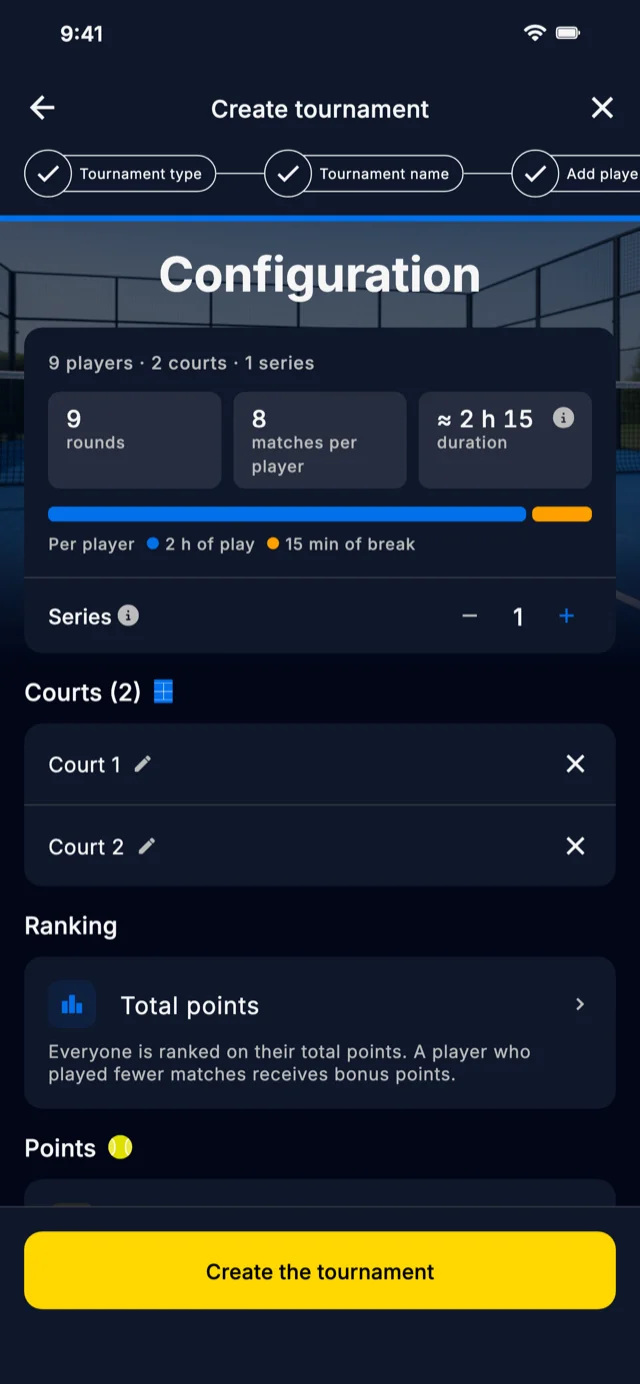
The rotations. This is our core business and where we invest the most. You can check it before you even create your tournament: the setup screen shows the number of matches per player, how the byes are spread and the balance of partners and opponents. If the grid on offer does not suit you, you draw again.
The formats. Americano and Mexicano, each in three variants, Classic, Mixed and Team. The Mexicano pairings can be tuned depending on whether you want balanced matches or a genuine contest between the top ranked players.
Players and courts. The player count is free, not just multiples of four. It handles up to 10 courts at once. Since version 3.2 the line up can even change during a tournament, to deal with someone leaving early or, in Mexicano, arriving late.
What the players see. This is our other strong difference. Every participant joins the tournament by scanning a QR code, then follows their next match, their partners and the live leaderboard from their own phone. On top of that, the organiser can hand over score entry: a player requests access from their phone, the organiser approves it with one tap, and that player can then enter results freely. On a multi court tournament that changes everything, since each court becomes self sufficient instead of queuing in front of the organiser. The leaderboard can also still be shown on a club TV or tablet, and the results export at the end of the session.
The model. The download is free and a 7 day premium trial is offered. The premium subscription unlocks multi court management among other things, with the free version staying limited to one court. That is our boundary, and it is stated before you build your tournament rather than at the moment you confirm it.
It keeps evolving
The app gets new features regularly, and a good share of them come straight from the organisers who use it every week. If something is missing or getting in your way, write to us at contact@americano-padel.app. Requests are read, and plenty of them end up being built.
The app is rated 4.9 out of 5 and used in more than 75 countries. How it works in detail is described in our complete feature guide.
Which solution for your situation
The criteria carry different weight depending on what you are organising.
An evening with friends, four to eight players, one court, twice a year. A paper sheet or a spreadsheet template does the job. Installing an app for two sessions a year makes little sense, and an eight player rotation fits on one page.
A regular group, eight to sixteen players, one or two courts, every week. This is where automation starts to pay off. The decisive criteria are flexibility on numbers, because there is always a last minute absentee, and the shared leaderboard, because the group wants to follow along.
A club, variable numbers, several courts, several formats. Format coverage and multi court management come ahead of everything else. Add the screen display, which changes how the event feels on the players’ side.
A corporate or inter club event, twenty players and up. Rotation quality and handing over score entry become critical: at that scale, a lone organiser collecting every score turns into the bottleneck of the evening. Exporting the results matters too, because you will have to circulate an official ranking afterwards. Our organiser’s guide covers the full logistics of that kind of event.
Three traps when choosing
Trusting the number of formats advertised. A tool that claims “more than ten formats” is no use to you if the two you actually run are handled badly. Test your real formats with your real numbers before committing.
Testing with a round number. Create your trial tournament with 11 players, not 12. That is exactly where tools separate, on bye management and on rotation quality when the count does not come out even.
Discovering the paywall mid session. Run a full trial tournament, right through to the final leaderboard, before your first real evening. You will know where the boundary sits and you will not discover it in front of twenty people.
Frequently asked questions
Do you really need an app to run an americano?
No, not always. Up to eight players on one court, a paper sheet or a spreadsheet template is plenty. Automation starts to pay off once the group goes past ten, once you use several courts, or once you organise regularly. It is the time spent recalculating a rotation after a withdrawal that justifies the tool, not the tournament itself.
Are there any genuinely free padel tournament apps?
Some online solutions are free with no limit, usually at the price of a mandatory connection and reduced features. Most mobile apps run on freemium: part of it is accessible without paying, the rest by subscription. The useful criterion is not the advertised price but exactly where the limit sits, and whether it is stated before you have built your tournament.
How can you tell whether an app handles odd player numbers well?
Create a trial tournament with 11 or 13 players and look at two things: the number of matches each player gets, and how the byes are spread. A good tool produces tiny gaps between players. A bad one sits the same people down several times while others never stop.
Can players follow the tournament from their own phone?
That depends on the tool, and the gap is wide. Some stop at a view only link, others let every player join the tournament, by scanning a QR code for instance, to see their next match and the live leaderboard. The most complete ones let the organiser hand score entry over to other participants, which stops everything going through one person on a multi court tournament.
Can you switch tools mid season?
Yes, but expect the history not to follow. Past tournaments and cumulative rankings generally stay in the old tool. If your group keeps a standing over time, switch between two seasons instead, or accept a reset on a clear date announced to the players.
Choosing a tournament tool comes down to choosing what you accept doing by hand. The spreadsheet leaves everything to you, the online generator takes the rotation, the dedicated app also takes the scores, the leaderboard and the surprises. But between two apps advertising the same thing, it is rotation quality and the autonomy left to the players that make the real difference on court.
If you want to try the third family, Americano Padel Manager covers the six Americano and Mexicano formats, accepts any player count, handles up to 10 courts, and lets every player join the tournament from their phone. The download is free on iPhone and Android, with a 7 day premium trial so you can make up your mind before committing.