 Americano Padel Manager
 Mexicano padel: rules, how it works and format variants
Mexicano is a padel tournament format where matches are organized based on the rankings in real time. After a random first round, top-ranked players face each other while lower-ranked players compete among themselves. The result: increasingly balanced matches as the tournament progresses.
This format is especially suited for groups with mixed skill levels. Unlike Americano where pairings are drawn randomly, Mexicano self-balances naturally thanks to its dynamic matchmaking system.
What is the Mexicano format in padel?
Mexicano is an individual competition played in doubles. Each player accumulates personal points match after match, and the rankings update in real time. These rankings determine the team compositions and matchups for the next round.
The core principle: the more you win, the stronger your opponents become. Conversely, if you lose several matches in a row, you face players at a similar level. This mechanism guarantees competitive matches for everyone, from beginners to advanced players.
Key difference with Americano
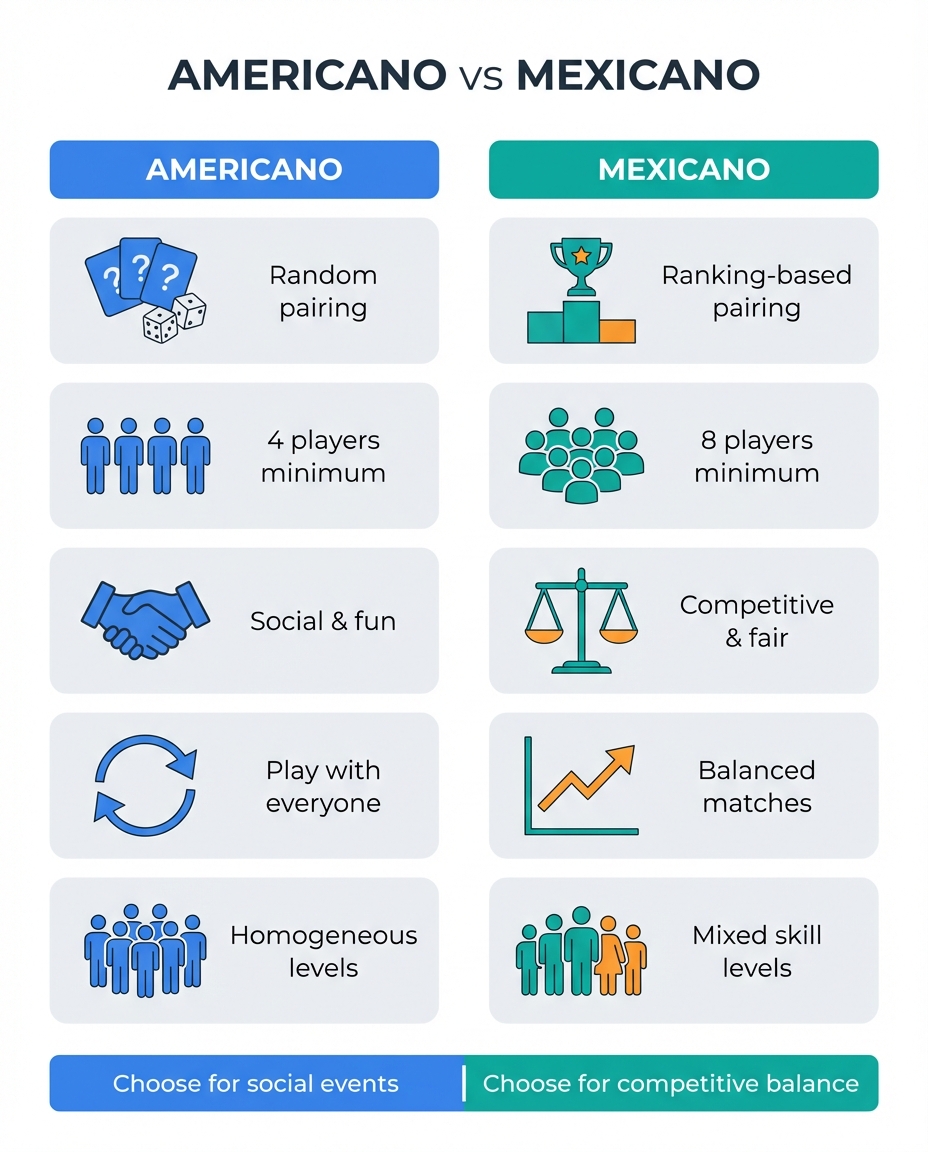
In Americano, pairs are formed randomly (or through a rotation algorithm) so that every player meets everyone else. In Mexicano, pairs are dictated by the rankings: you play with and against players close to your level. Americano focuses on variety, Mexicano focuses on competitive balance.
How does a Mexicano tournament work?
First round: random pairings
The tournament starts just like an Americano: the teams and matchups for the first round are drawn at random. This opening round serves as a baseline to establish an initial ranking.
Following rounds: the rankings decide
From the second round onward, the live rankings take over. Players are sorted by cumulative points, then grouped in sets of 4 (one per court). Within each group of 4 players, teams are formed to balance skill levels.
The matchmaking system explained
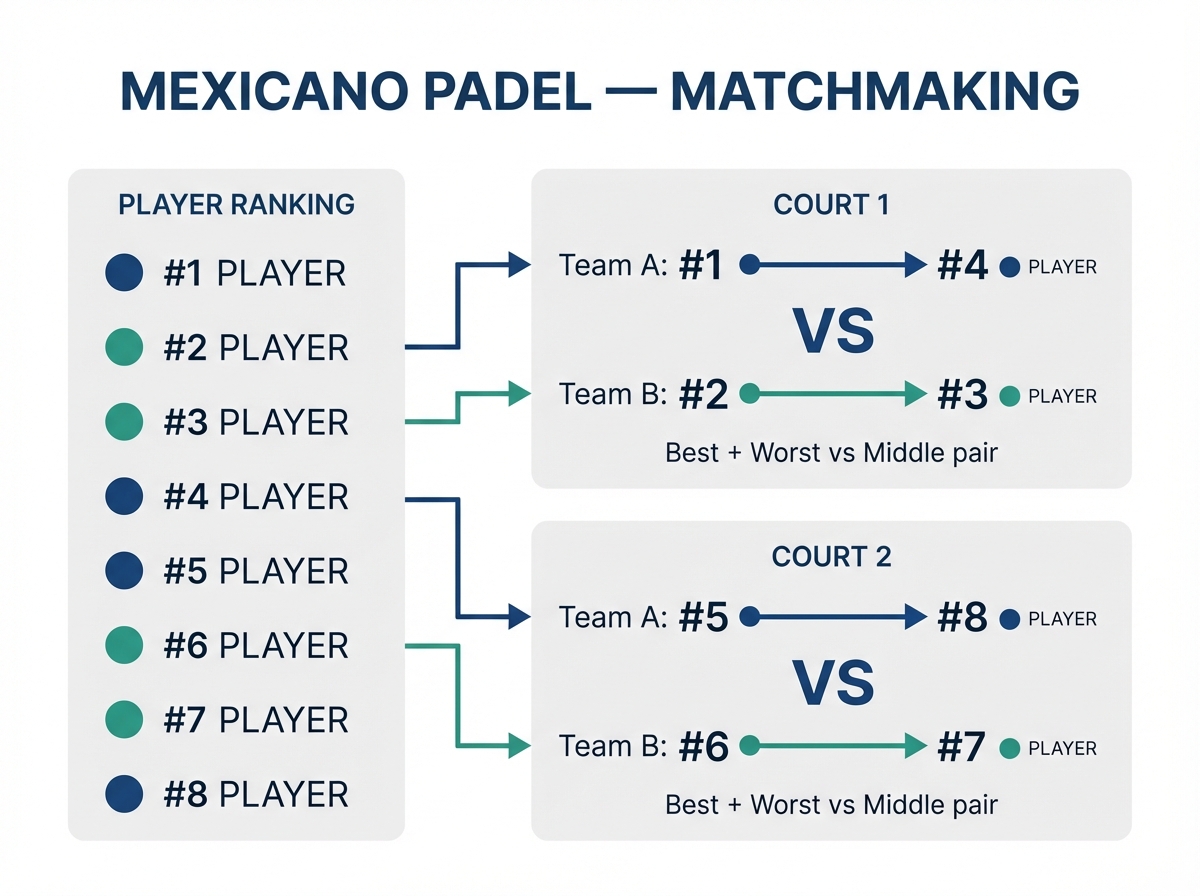
In a group of 4 players ranked 1st, 2nd, 3rd, and 4th, the pairs are formed like this:
- Team A: 1st + 4th (the best player with the lowest-ranked)
- Team B: 2nd + 3rd (the two middle players)
This crossover ensures teams of roughly equal overall level. The 1st lifts the 4th, while the 2nd and 3rd form a balanced pair.
✓ Did you know?
Some organizers use a 1+3 vs 2+4 pairing instead of 1+4 vs 2+3. Both variants exist, and there is no official rule dictated by any federation. The 1+4 vs 2+3 pairing is the most common because it produces more balanced matches.
The same principle applies on every court: players ranked 5th to 8th form two teams (5+8 vs 6+7), and so on.
Organizing a Mexicano tournament with Americano Padel Manager
Managing a Mexicano tournament by hand is tedious: you need to recalculate the rankings after each round, form new pairs, and assign courts. That is where Americano Padel Manager simplifies everything.
The app supports all three Mexicano variants (Classic, Team, and Mixed) and automates the entire process:
- Automatic match generation: enter the scores, and the algorithm calculates the next pairs based on the rankings
- Real-time rankings: each player can track their progress point by point
- Multi-court management: from 2 to 10 courts managed simultaneously, with rotation optimization
A tournament of 12 players on 3 courts can be set up in under 2 minutes. Players can check the rankings and their upcoming matches live from their phone.
Scoring system in Mexicano
The scoring in Mexicano is identical to Americano: every point scored by your pair is added to your personal total.
How it works in practice
Each match is played to a set number of points decided in advance. The most common formats:
- 16 points: quick matches (~8 minutes), ideal for large groups
- 24 points: standard duration (~12 minutes), the most widely used
- 32 points: longer matches (~16 minutes), for smaller groups
If a 24-point match ends 14-10, each player on the winning team receives 14 points and each player on the losing team receives 10 points. All 24 points of the match are always distributed among the four players.
To learn more about padel scoring systems, check out our complete scoring guide.
Who wins the tournament?
The player with the highest number of cumulative points after all rounds is declared the winner. In case of a tie, the tiebreaker is based on results: the number of wins, then draws, then losses. The points difference is meaningless between two players who have played the same number of rounds, since each round distributes a fixed total.
Mexicano vs Americano: what is the difference?
Both formats share the same individual scoring system, but they differ on one essential aspect: how teams are formed.
| Criteria | Americano | Mexicano |
|---|---|---|
| Pair formation | Random or algorithmic rotation | Based on rankings |
| Minimum players | 4 | 8 |
| Mixed skill levels | Can produce unbalanced matches | Self-balances naturally |
| Atmosphere | Very social, you play with everyone | Competitive but fair |
| Organization complexity | Simple (fixed rotation) | Requires a calculation tool |
When to choose Mexicano
- Your group mixes beginner and advanced players
- You have 12 or more players and at least 3 courts
- You want close matches from start to finish
- Participants are looking for a competitive edge
When to choose Americano
- Your group has a relatively even skill level
- You are a small group (4 to 8 players)
- The goal is mainly social: everyone plays with everyone
- You do not have a tool to manage real-time rankings
Mexicano variants
Team Mexicano
In Team Mexicano, teams are formed before the tournament and remain fixed throughout the competition. The dynamic matchmaking system works exactly the same way: the best-ranked teams face the best-ranked teams.
This format is ideal when participants come as a duo (couples, regular partners) and want to stay together while benefiting from the automatic match balancing.
Mixed Mexicano
Mixed Mexicano ensures that each team is composed of one man and one woman. The rankings and pairings follow the same logic as classic Mexicano, but with this gender mix requirement.
It is the perfect format for mixed club evenings or corporate events where you want to guarantee gender-balanced pairs.
How many players and courts do you need?
A Mexicano tournament requires a minimum of 8 players and 2 courts. The basic rule: 1 court for every 4 players.
| Players | Courts | Estimated duration |
|---|---|---|
| 8 | 2 | ~1h30 |
| 12 | 3 | ~2h |
| 16 | 4 | ~2h |
| 20 | 5 | ~2h30 |
The duration depends on the number of rounds and the points format chosen. With 24-point matches (~12 minutes), expect 6 to 8 rounds for a full tournament, which is about 2 hours of play.
No need for a multiple of 4
Contrary to popular belief, the number of players does not need to be divisible by 4. You can start a tournament with 9, 10, 11, 14, or any number of players. The principle is simple: each round, some players sit out while the others play.
Americano Padel Manager’s algorithm handles these sit-outs automatically and fairly:
- Sit-out time is distributed evenly among all players. Nobody sits on the bench two rounds in a row while someone else plays non-stop.
- Matches remain balanced despite the sit-outs. Pairings are always based on real-time rankings, whether you have 8, 11, or 17 players.
- The final ranking is fair: the algorithm accounts for the number of matches played by each player to keep the comparison equitable.
In practice, the difference between a 12-player and an 11-player tournament is barely noticeable. Players sitting out use the time to recover, hydrate, and watch the ongoing matches.
Tips for a successful Mexicano tournament
-
Choose the right number of points per match. For a group of 12+ players, the 24-point format is the best compromise between duration and intensity. With 8 players, you can go with 32 points.
-
Use an app. Mexicano requires recalculating the rankings and pairs after each round. Doing it by hand on paper leads to errors and wasted time. Americano Padel Manager handles everything automatically.
-
Plan a warm-up. Before the first round, allow 5 to 10 minutes for warm-up. Players who start cold risk losing their first match and dropping to the bottom of the rankings right away.
-
Announce the rules clearly. Before the kick-off, explain the Mexicano concept to participants: pairs change, the rankings decide, every point counts. This avoids surprises.
What is the difference between Americano and Mexicano in padel?
In Americano, pairs are formed randomly so that every player meets everyone. In Mexicano, pairs are dictated by the real-time rankings: the best players play with and against the best. Americano focuses on social variety, Mexicano on competitive balance.
How many players do you need for a Mexicano tournament?
You need a minimum of 8 players and 2 courts. The number of players does not need to be divisible by 4: you can play with 9, 11, 14, or any number. The app automatically manages sit-outs and distributes them fairly among all players.
How does the scoring system work in Mexicano?
Every point scored by your pair is added to your personal total. If a 24-point match ends 14-10, the winners receive 14 points each and the losers receive 10 points each. The player with the most cumulative points at the end of the tournament wins.
What is Team Mexicano?
Team Mexicano is a variant where teams are formed before the tournament and remain fixed. The dynamic matchmaking system works the same way: the best-ranked teams face the best-ranked teams. It is ideal when participants want to stay as a duo.
Can you organize a Mexicano tournament without an app?
Technically yes, but it is not practical. Mexicano requires recalculating the rankings and pairs after each round, which is tedious and error-prone on paper. An app like Americano Padel Manager automates the entire process and supports up to 10 courts simultaneously.
Launch your first Mexicano tournament
Mexicano is the ideal format for tournaments where fun and fairness go hand in hand. Whether you are organizing a friendly evening or a club event with 20 participants, the dynamic matchmaking system guarantees close matches from the first to the last round.
Download Americano Padel Manager for free on App Store and Google Play to create your first Mexicano tournament in under 2 minutes. The app handles the rankings, pairings, and courts automatically, so you can focus on the game.