 Americano Padel Manager
 Padel tournaments: categories, ranking and how they work
You keep seeing tournaments labelled P25, P100, P500 or M25 without understanding what they mean? These codes refer to padel tournament categories organized by national federations. The number corresponds to the points awarded to the winner: a P25 gives 25 points, a P500 gives 500. The higher the number, the more competitive the tournament.
This category system exists in most countries where padel is structured. The naming may vary between federations (P25, M25, or other prefixes), but the principle is the same everywhere: a tournament pyramid that allows every player to find competitions suited to their level.
Tournament categories: from P25 to P2000
Most national federations organize their tournaments according to a tiered category system. Here is the most common structure.
P25 and P50: tournaments for beginners in competition
The P25 is the entry point to official competition. It targets players who have mastered the basics of padel and want to experience their first tournament. The P50, recently introduced in some countries, bridges the gap between P25 and P100.
These tournaments often take place over a half-day or an evening. The format usually begins with group stages (which guarantee several matches for each pair), followed by a single-elimination bracket. The atmosphere is friendly and welcoming.
P100 and P250: the heart of club competition
The P100 is the benchmark tournament for regular club players. The level steps up: pairs are more solid, rallies more tactical. This is often where players start taking competition seriously.
The P250 marks the transition to confirmed competition. Players who perform well in P250 events typically have strong technical skills (net approaches, wall play, lobs) and genuine tactical awareness.
P500 to P2000: national high-level play
| Category | Winner’s points | Player profile |
|---|---|---|
| P500 | 500 pts | Very strong club players |
| P1000 | 1,000 pts | Top regional players |
| P1500 | 1,500 pts | National elite |
| P2000 | 2,000 pts | Best players in the country |
Tournaments P500 and above are open to all ranking levels (no restrictions). They often span a full weekend and sometimes offer prize money. The P2000 represents the pinnacle of the national circuit in most countries.
✓ Why do the letters change between countries?
In France, they use P25, P100, P500. In Mauritius, it becomes M25. In Spain or Argentina, categories have different names. The prefix changes, but the number always means the same thing: the points awarded to the winner. If you see a tournament with a number, you immediately know where it sits in the pyramid.
How does the padel ranking system work
Each national federation manages its own padel ranking. The basic principles are similar from one country to another.
The rolling ranking system
The ranking works on a 12-month rolling window. Only your best results during this period count. In practice:
- You earn points at each tournament based on your final placement (winner, finalist, semi-finalist, etc.) and the tournament category
- Only your best results are kept (usually between 8 and 12 depending on the federation)
- Poor results do not penalize you: they simply don’t count
- The ranking is updated every month (sometimes every week)
This system rewards consistency: the more tournaments you play, the more chances you have to accumulate good results.
Pair weight
To register for a tournament, most federations use the concept of pair weight. The calculation is simple: you add the rankings (or national positions) of both players. A pair with a lower weight is considered stronger.
This criterion serves two purposes:
- Validating registrations when the draw is full (the best pairs get priority)
- Distributing seeds in the draw to balance the competition
Cuts: who can play in which tournament?
To prevent top players from dominating lower categories, federations apply cuts (ranking thresholds). The principle is simple: if you are ranked too high, you can no longer enter entry-level tournaments.
Typical restriction examples:
- P25: restricted for the highest-ranked players in the country
- P100: restricted for the national top rankings
- P250: less severe restrictions
- P500 and above: no restrictions, open to all
The exact thresholds vary from country to country and are often different between men’s and women’s draws. Check your federation’s website to find the current cuts.
⚠️ Important
The ranking used to verify cuts is usually the last official ranking published before the tournament date, not the one at the time of registration. A player can register and be rejected if their ranking changes in the meantime.
Organize your own tournaments between official competitions
Between official tournaments, many clubs and groups of friends organize Americano or Mexicano format tournaments. These formats are perfect for regular sessions: each player switches partners every match, which guarantees maximum encounters and a friendly atmosphere.
The Americano Padel Manager app simplifies the entire organization. In under 2 minutes, it automatically generates matches with optimal player rotation, manages the live leaderboard and lets you share results instantly. Whether you play with 4 or 40 players, on 1 to 10 courts, the app adapts. Thousands of clubs in over 75 countries already use it to manage their weekly sessions.
It is an excellent complement to official competitions: Americano tournaments allow you to play regularly, improve and prepare before facing ranked tournaments. If you are new to these formats, check out our complete guide to Americano rules.
How a tournament works: group stage and knockout bracket
Most padel tournaments follow a two-phase format.
Group stage (morning): pairs are split into groups of 3 or 4. Each pair plays against all others in their group. This phase guarantees multiple matches for each team, even in case of defeat. Group matches often use a shortened format (super tie-break or short sets).
Knockout bracket (afternoon): the best pairs from each group qualify for a single-elimination bracket. Matches are often played in a longer format (2 or 3 sets). The bracket continues until the final.
Common match formats:
- 3 sets of 6 games with tie-break at 6-6 (standard format in professional tournaments)
- 2 sets + super tie-break to 10 points in the 3rd set (most common in amateur play)
- Deciding point at 40-40, no advantage (to speed up matches)
✓ Good to know
In official tournaments, padel is played exclusively in doubles (2 vs 2). There are no singles draws in sanctioned competitions.
How to enter your first tournament
Ready to take the plunge? Here are the steps.
- Get a licence from your national padel (or tennis) federation. It is mandatory for sanctioned tournaments.
- Find a partner of similar level. Tournament padel is played in fixed pairs.
- Search for a tournament on your federation’s website or app. Start with a P25 or the local equivalent.
- Register online with your partner. Entry fees are typically between €15 and €30 per player.
- Wait for confirmation. The referee validates registrations based on pair weight and available spots.
- Show up on the day. The schedule with groups and match times is published the day before the tournament.
✓ Tip for your first tournament
Don’t aim for the win. Your first tournament is an opportunity to experience the atmosphere, understand the format and face other players. The group stage guarantees several matches, so enjoy every encounter.
Above national tournaments: the professional circuit
The best players from each country can access the international professional circuit, which is split into two levels.
The FIP Tour: the gateway to professional padel
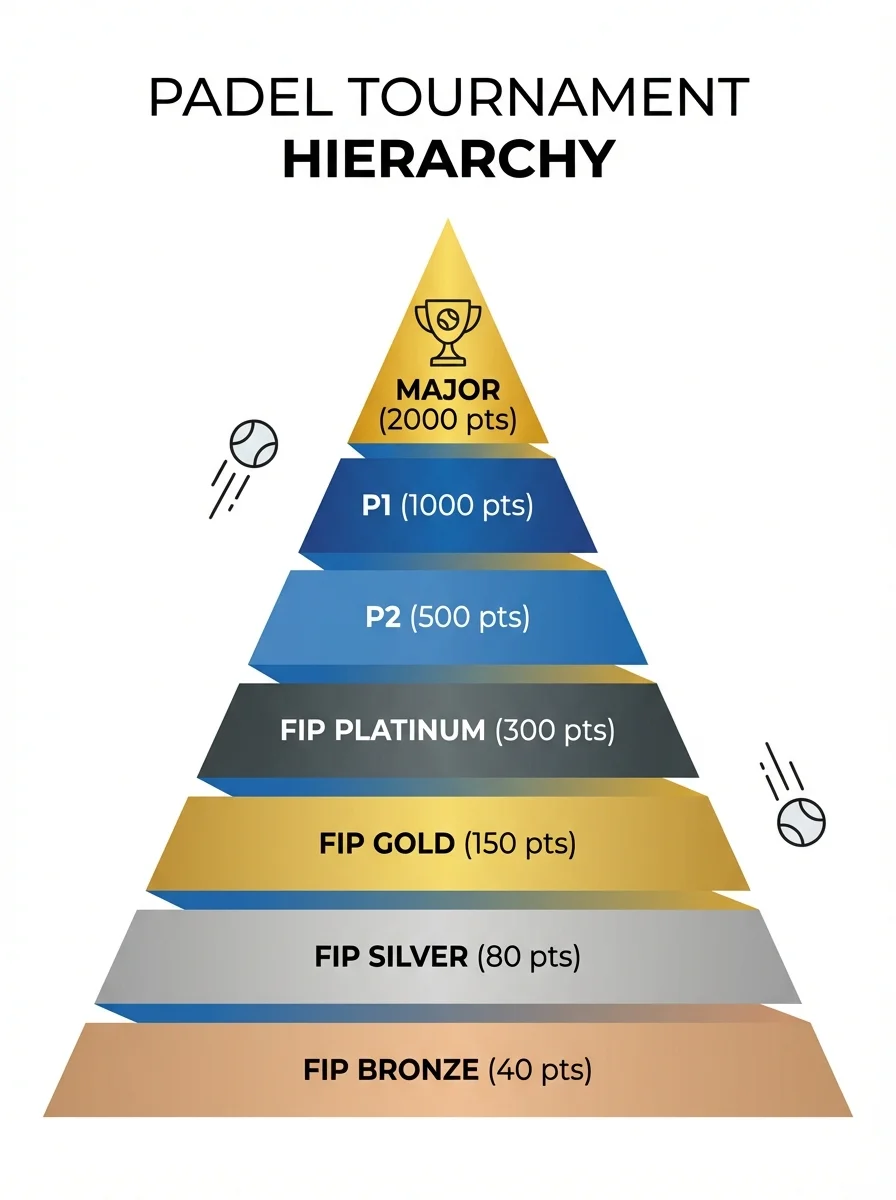
The CUPRA FIP Tour bridges the gap between national circuits and the top of world padel. It includes four categories:
| Category | FIP points (winner) | Prize money |
|---|---|---|
| Platinum | 300 pts | €120,000–€150,000 |
| Gold | 150 pts | €50,000–€80,000 |
| Silver | 80 pts | €15,000–€30,000 |
| Bronze | 40 pts | €7,000–€10,000 |
A player who dominates their national circuit can try their luck in FIP Bronze, then progress to Silver, Gold and Platinum.
Premier Padel: the world summit
Premier Padel is the elite circuit, the equivalent of ATP in tennis. It includes:
- 4 Majors (2,000 FIP points, €525,000 prize money): Qatar, Italy, France, Mexico
- 10 P1 tournaments (1,000 points, €250,000)
- 11 P2 tournaments (500 points)
- The Finals in Barcelona in December (1,500 points, world top 16)
The FIP world ranking takes into account the 22 best results over 52 weeks, across all circuits (Premier Padel and FIP Tour). In 2026, the calendar covers 26 tournaments in 18 countries.
Frequently asked questions
What is a P25, P100 or P500 in padel?
These are padel tournament categories organized by national federations. The number corresponds to the points awarded to the winner: a P25 gives 25 points, a P500 gives 500. The higher the number, the higher the level. The naming may vary between countries (P25, M25, etc.) but the principle is universal.
How does the padel ranking work?
The ranking is based on your best tournament results over the last 12 months (rolling window). Only your best performances count, poor results do not penalize you. The ranking is updated monthly by your national federation. At international level, the FIP ranking considers the 22 best results over 52 weeks.
What are cuts in padel?
Cuts are ranking thresholds that prevent players ranked too high from entering lower-category tournaments. For example, a top national player generally cannot play a P25. The goal is to ensure a homogeneous level and give less experienced players a fair chance. Thresholds vary by country and category.
What is the difference between Premier Padel and the FIP Tour?
Premier Padel includes the most prestigious tournaments (Major, P1, P2) with the best players in the world and the highest prize money. The FIP Tour (Platinum, Gold, Silver, Bronze) is accessible to more players and serves as a gateway to the professional circuit. Both circuits feed into the same FIP world ranking.
Which tournament should beginners start with?
Start with a P25 (or the local equivalent in your country). These tournaments are designed for players new to competition. The group stage format guarantees several matches, and the atmosphere is generally friendly. You will need a federation licence, a partner and online registration through your federation.
Whether you are playing your first P25 or watching the Majors on television, understanding tournament categories and the ranking system gives meaning to every match. And for your sessions with friends or at the club, download Americano Padel Manager for free and organize a tournament in minutes. Also check out our guide on padel scoring to master the scoring on the court.