 Americano Padel Manager
 Padel Training Drills for 2 Players: 10 Drills to Improve at Every Session
You are two, you have a court and an hour ahead of you. How do you make the most of it? Padel training drills for 2 players let you work every shot with more repetitions than in a match, while keeping the intensity of a real rally. Here are 10 drills ranked by level, from beginner to advanced player, with a ready-to-use session plan.
Why Training with 2 Players in Padel Is So Effective
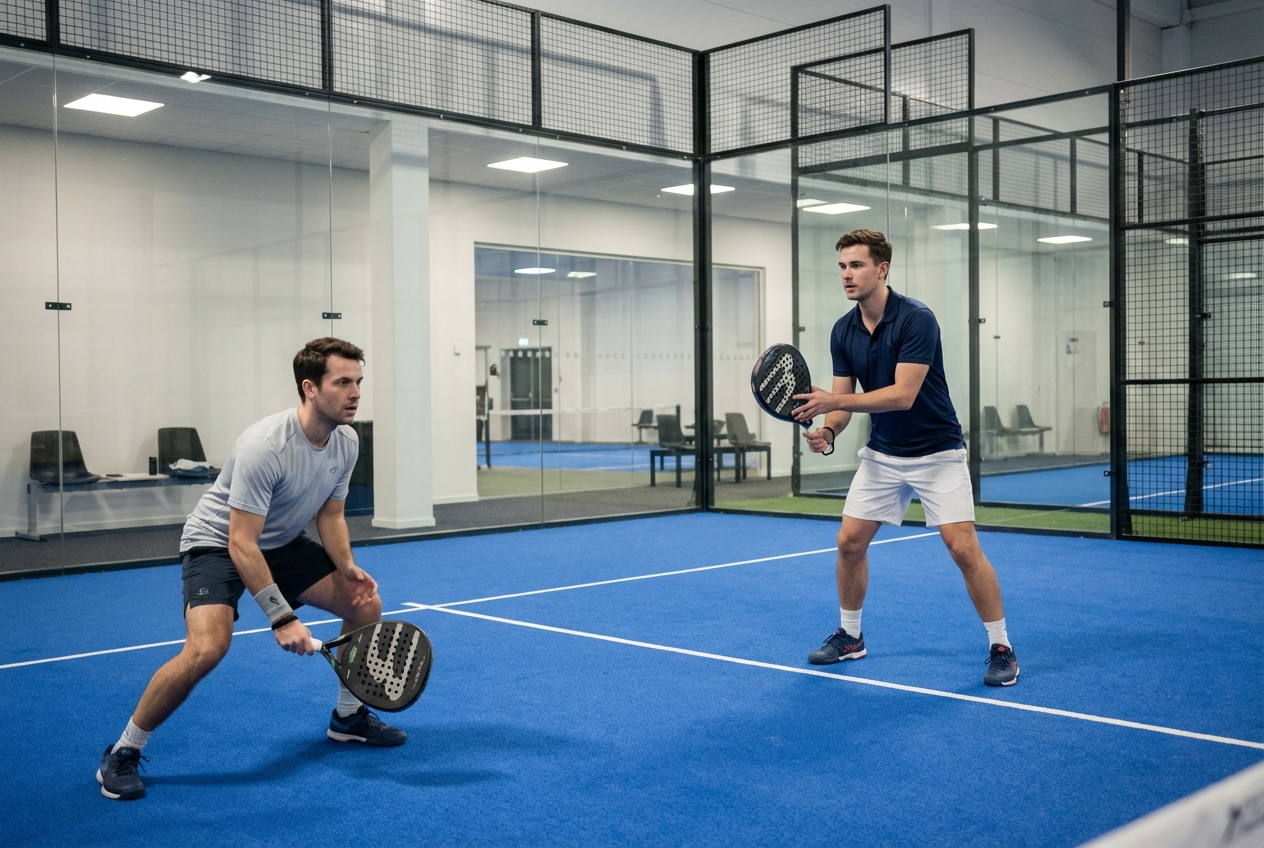
Padel is played in fours. But paradoxically, it is in twos that you improve the fastest. In a match, each player touches the ball once in four shots. In two-player training, it is one shot in two. The volume of repetitions doubles.
More Shots, More Repetitions
In one hour of a 4-player match, a player hits an average of 150 to 200 balls. In a 2-player training session, that number climbs to 400 or 500 shots. This difference is considerable for motor learning: the more a movement is repeated under good conditions, the more it becomes automatic.
Professional players like Agustín Tapia and Miguel Lamperti regularly train in twos diagonally to work on consistency and precision. If this method works at the highest level, it also works for amateurs.
A Format Suited to All Levels
The advantage of the 2-player format is its flexibility. Each drill can be simplified or made more complex depending on the players’ level. A beginner will work on consistency of the forehand down the line. An intermediate player will add variations (slice, topspin) and movement. An advanced player will chain high-intensity game situations.
Before You Start: The Two-Player Warm-Up
Never skip the warm-up. Even in training, your muscles and joints need to be prepared. A structured warm-up reduces the risk of injury by more than 50%. If you are looking for a complete routine, check out our padel warm-up guide.
Dynamic Warm-Up (5 min)
Start without a racket:
- High knees and heel kicks: 30 seconds each
- Lateral shuffles: 5 back-and-forths across the court width
- Torso rotations: 10 on each side, arms outstretched
- Large arm circles: 10 forward, 10 backward
- Wrist and ankle rotations: 10 in each direction
Building Up with the Ball (5 min)
Take your racket and exchange gently with your partner:
- Face-to-face volleys (1 min): 3 metres apart, controlled soft volleys
- Baseline rallies (2 min): down-the-line rally at moderate pace
- Lobs and bandejas (2 min): one player lobs, the other replies with a bandeja or light smash
The goal is not to win the point but to find the rhythm and eye-racket coordination.
5 Padel Drills for Beginners (Level 1)
These drills are designed to build technical foundations. The key word: consistency before power.
1. The Down-the-Line Rally
The simplest and most effective drill for a beginner. Both players stand at the back of the court, each on their side, and rally parallel to the side wall.
How to do it:
- Always aim for the same corridor (forehand or backhand)
- Count consecutive rallies without an error
- Target: reach 20 exchanges, then 30, then 50
What it works: consistency, ball depth, recovery after the shot.
✓ The right habit
After every shot, return to the centre of your half of the court. This recovery position is the foundation of positioning in a match.
2. The Basket Feed on the Forehand
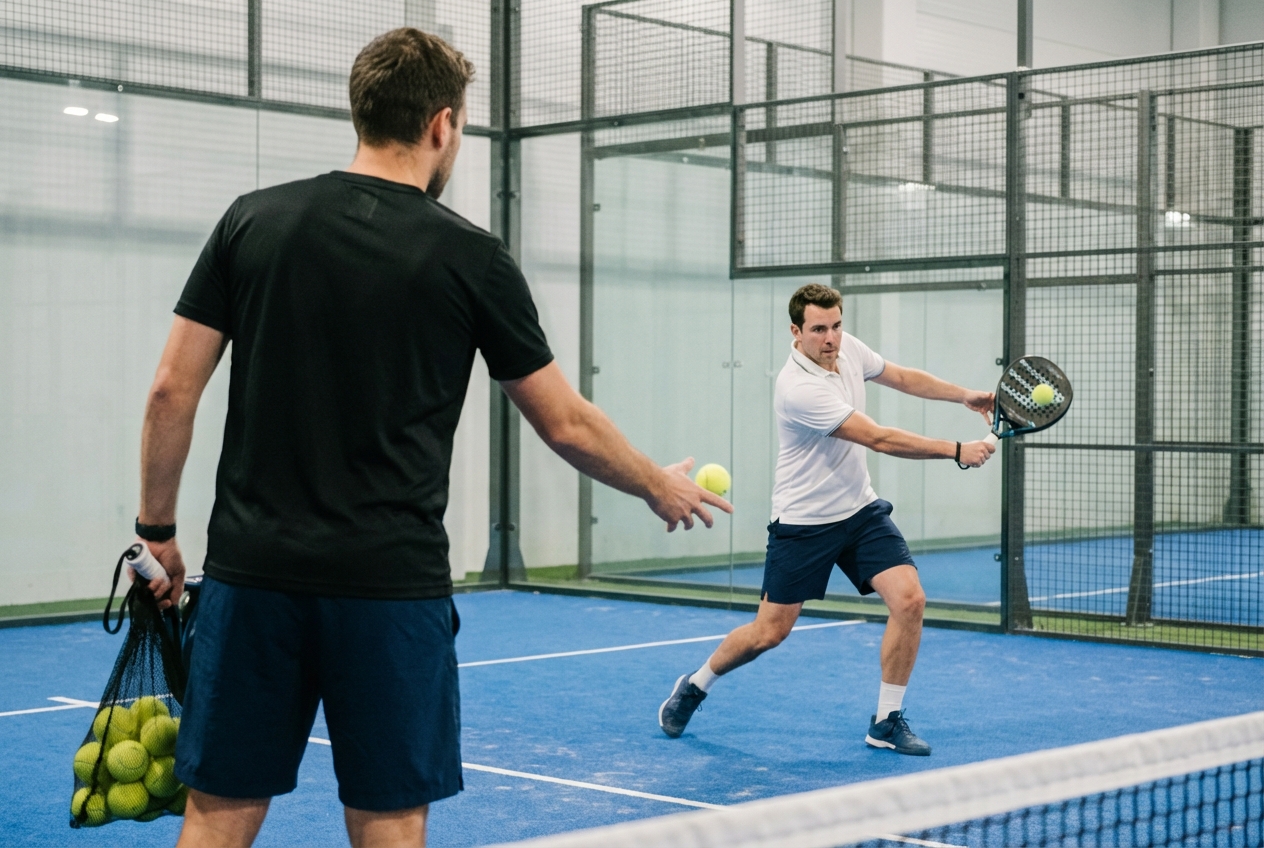
One player takes a basket of balls (or a bag) and feeds their partner. The receiving player works a specific shot in series.
How to do it:
- The feeder stands at the net, basket beside them
- They send the ball on the bounce toward their partner’s forehand zone
- The partner hits 20 balls on the forehand, then 20 on the backhand
- Swap roles
What it works: pure technique, without the pressure of a rally. Ideal for correcting a movement.
3. Controlled Face-to-Face Volleys
Both players stand on either side of the net, 2 metres from it. The goal is to chain volleys without the ball touching the ground.
How to do it:
- Start slowly, in full control
- Alternate forehand and backhand
- Target: 30 consecutive volleys, then 50
- Variation: one player only plays forehand, the other only backhand
What it works: reflexes, ball touch, high racket position. The volley is the most played shot in padel matches. To master all its variations, see our complete padel shots guide.
4. The Lob and Back Glass Return
One player is at the net, the other at the back. The back player sends lobs over their partner. The net player turns around, lets the ball bounce off the back glass and puts it back in play.
How to do it:
- The back player lobs high and deep
- The net player waits for the bounce off the glass, then strikes
- After 10 balls, swap positions
- Advanced variation: the back player hits a smash or a bandeja instead of lobbing
What it works: reading the trajectory after the glass, strike timing, positioning at the back of the court.
5. The Serve and Return
One player serves, the other returns. This drill reproduces the most frequent sequence at the start of a point.
How to do it:
- The server works on placement (not power)
- The returner focuses on the depth of their return
- After the return, the point is not played: put a new ball in
- 10 serves forehand, 10 backhand, then swap
What it works: serving consistency, reading the bounce on the return, moving toward the net after the serve.
Structure Your Sessions with Americano Padel Manager
After 2-player training, nothing beats putting your progress to the test in real conditions. Americano Padel Manager lets you organise a tournament in under 2 minutes, with automatic partner rotation and real-time rankings.
The app generates matches for any number of players (from 4 to 40), handles distribution across multiple courts and calculates the standings automatically. Whether you are a group of friends meeting up after training or a club organising Americano evenings, the app adapts to your format.
✓ From training to tournament
Invite other players after your 2-player session and launch an Americano tournament in a few taps. The algorithms guarantee that every player plays with and against everyone.
5 Padel Drills for Intermediate and Advanced Players (Level 2)
You have mastered the basics? These drills add movement, intensity and realistic game situations.
6. The Diagonal Cross-Court: The King of Drills
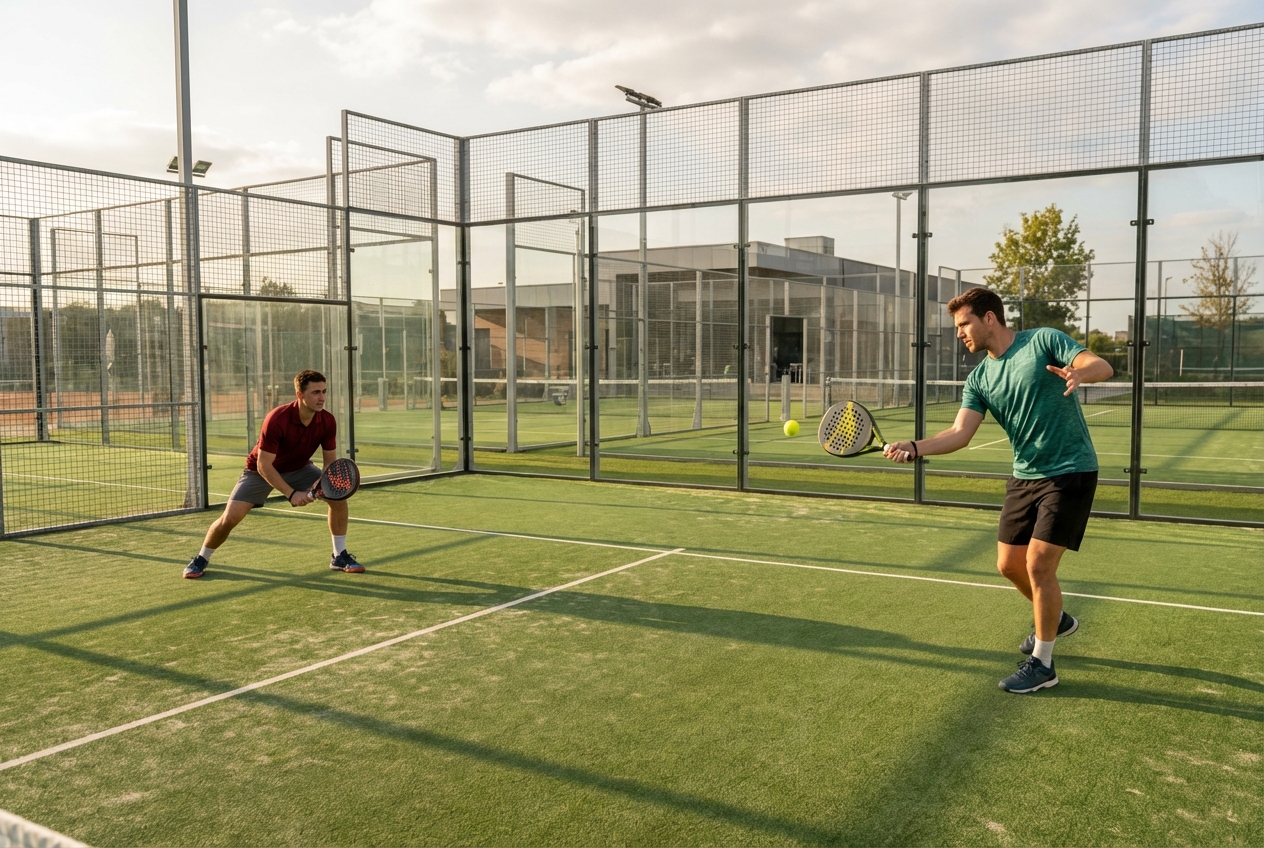
This is the drill most recommended by coaches and professional players. Two players each occupy a half-court diagonally and rally exclusively cross-court.
How to do it:
- Player A at the back right, Player B at the back left (diagonally)
- Every ball must land in the opposing diagonal half-court
- Play 5-minute sets, then switch diagonals
- Variations: ban the lob, or conversely play only lobs
What it works: consistency under pressure, directional precision, endurance. In a match, the majority of rallies are played diagonally. This drill reproduces that exact situation.
Why it is the best drill: you are solely responsible for every lost ball. No partner to compensate. It is this demand that accelerates progression.
7. The Attack/Defence Basket Feed
An advanced version of the basket feed. The feeder sends two consecutive balls that simulate a real game situation.
How to do it:
- Ball 1: high volley at the net (the player moves up and strikes)
- Ball 2: deep lob (the player retreats and plays a bandeja or smash)
- Chain 15 sequences, then swap roles
- The goal is to work the net/baseline transition without stopping
What it works: vertical movement (up/down), fast decision-making, transition between attack and defence.
8. The Volley-Reset-Lob-Bandeja Loop
A continuous loop drill chaining 4 different shots. It is the perfect exercise for ball control and coordination.
How to do it:
- Player A at the net, Player B at the baseline
- A plays a volley → B plays a short reset → A plays a lob → B plays a bandeja → back to the start
- The loop runs continuously for 3 minutes
- Swap positions
What it works: shot chaining, ball touch, constant adaptation of the movement. It is also an excellent warm-up before a match.
9. The 1v1 Diagonal: The Simulated Match
The 1v1 diagonal format turns the drill into a competition. Each player covers a diagonal half-court and plays points normally.
How to do it:
- Delimit the playing zone: each player uses their diagonal half of the court
- Underhand serve, as in a match
- Count points in padel format (15, 30, 40, game)
- Play short sets (first to 3 games)
What it works: decision-making, score management, tactical positioning. This format is increasingly practised in clubs for training with just two people.
⚠️ Mind the court coverage
In 1v1, you cover a half-court alone. The physical effort is intense. Plan regular breaks and stay hydrated between games.
10. The Corner Defence Drill
One player at the net attacks, the other at the back defends. The net player alternately sends balls into the two back corners.
How to do it:
- The net player hits firm volleys alternating between right and left
- The back player must defend and put every ball back in play
- After 2 minutes, swap roles
- Variation: the back player can only reply with lobs
What it works: rapid lateral movement, defence under pressure, reading the trajectory. In a match, knowing how to defend in the corners makes the difference between an average and a good player. To avoid common technical mistakes in defence, see our beginner mistakes guide.
How to Structure a Typical 60-Minute Session
Having drills is good. Knowing how to organise them into a coherent session is better. Here is a ready-to-use plan.
Detailed Schedule
| Time | Exercise | Goal |
|---|---|---|
| 0-5 min | Dynamic warm-up without ball | Prepare the body |
| 5-10 min | Warm-up with ball (volleys + rallies) | Find the rhythm |
| 10-20 min | Technical drill (basket feed or rally) | Work a specific shot |
| 20-35 min | Tactical drill (cross-court or loop) | Work shot chaining |
| 35-50 min | Competitive drill (1v1 or attack/defence) | Match intensity |
| 50-55 min | Cool down (slow rallies) | Active recovery |
| 55-60 min | Static stretching | Flexibility and recovery |
✓ Vary drills at every session
Do not do the same exercises every week. Alternate technical and tactical drills to challenge every aspect of your game.
Tips for Getting the Most Out of Every Session
Set one goal per session. Do not work on everything at once. Today it is the volley. Next time, it will be corner defence. Progression comes from targeted repetition.
Communicate with your partner. Before you start, decide together what you are going to work on. A drill only works if both players are fully committed to the exercise.
Film yourself. Prop your phone against the glass and film a series of shots. Watching your technique on video is often more revealing than any verbal advice.
Respect the work/rest ratio. For intensive drills (1v1, corner defence), alternate 2 minutes of effort with 1 minute of rest. Shot quality drops when fatigue sets in, and that is when bad habits form.
Plan 2 to 3 sessions per week. Consistency matters more than duration. Two well-structured 45-minute sessions are worth more than a 2-hour marathon where concentration fades.
Frequently Asked Questions
Can you really improve at padel by training with 2 players?
Absolutely. 2-player training offers twice as many shots per player as a 4-player match. Professional players like Tapia and Lamperti regularly use this format to work on consistency and precision. It is even considered the fastest way to improve technically.
How long should a 2-player training session last?
An ideal session lasts between 45 minutes and 1 hour, including the warm-up. Beyond that, concentration and shot quality decline. Two short and intense sessions per week are better than a single long one.
What is the best drill for a padel beginner?
The down-the-line rally (drill no. 1) is the best starting point. It works consistency, depth and recovery position — the three fundamentals of padel. Once you can sustain 30 consecutive exchanges, move on to face-to-face volleys.
Can you play a real padel match with 2 players (1 vs 1)?
Padel 1v1 is not an official format, but it is widely practised in training. The most common format is the 1v1 diagonal: each player covers a diagonal half-court. It is an excellent fitness and decision-making exercise.
Do you need a basket of balls to train with 2 players?
A basket of balls is useful for basket feed drills (exercises no. 2 and no. 7), but it is not essential. The majority of drills in this article are played as continuous rallies and only require one ball at a time.
From Training to Competition
You have worked your shots with 2 players. It is time to test them in real conditions. Download Americano Padel Manager and organise your next tournament in seconds. The app is free to try, works offline and handles everything: player rotation, court assignment, live standings. Over 75 countries are already using it. Your turn.