 Americano Padel Manager
Pozo padel: format rules and how to run one at your club
A pozo is a social tournament where each pair stays together and moves between several courts depending on its results. The winning pair goes up one court, the losing pair goes down one court, and the goal is to reach court 1. Matches are short, usually capped at 15 or 20 minutes, which is how a two hour session fits in five rounds or more.
The format comes from Spain and Latin America, where it has become the weekly fixture of countless clubs in just a few seasons. Here is exactly how it works, how it differs from an americano, and how to get the same dynamic when you run your tournament from an app.

What is a pozo in padel?
The Spanish word pozo means “well”. The image says it all: the courts are stacked like the levels of a well, and every pair tries to climb back up to the surface, meaning court 1, often called the centre court.
You enter as a pair, and you keep it
This is the feature that immediately sets the pozo apart from other social formats. Entries are taken by pair, and you play with the same partner from start to finish.
That changes the whole experience. You are not meeting a new partner every twenty minutes: you build an understanding, you fix your positioning round after round, and you improve together. For a duo that plays together regularly, this is the format that feels closest to real competition while staying friendly.
You move up and down one court
The club sets an explicit hierarchy between its courts: court 1 at the top, then court 2, court 3, and so on. At the start, the pairs are spread across those courts, usually by estimated level or by draw.
At the end of every round, the rule never changes:
- the pair that wins moves up to the court immediately above
- the pair that loses moves down to the court immediately below
- the pair that loses on the bottom court stays there and waits for a win to start climbing
- the pair that wins on court 1 stays there and defends its place
After a few rounds, the levels sort themselves out. The strongest pairs end up at the top fighting over the centre court, and everyone else plays balanced matches at their own level.
Matches are short and on a clock
A pozo is never played in sets. Two formulas dominate depending on the club:
- On the clock: every pair plays 15 or 20 minutes, a horn stops everybody at the same time, and the score at that moment decides the match.
- Short format: a 10 point tie break, or a best of 5 games match, which gives a similar length without needing a shared timer.
The timed formula is the most common because it synchronises the courts: everyone finishes together, so everyone changes court together. A typical two hour session therefore fits five to six rounds.
Pozo, americano or mexicano: what sets them apart
All three formats chase the same goal, getting a lot of people playing without a knockout draw. They differ on two questions: do I keep my partner, and what decides my next match?
| Partner | What decides the next match | Ranking | |
|---|---|---|---|
| Pozo | Fixed for the whole session | Moving up or down one court | The pair, by the court it reaches |
| Americano | Changes every round | A rotation calculated in advance | Individual, on total points |
| Mexicano | Changes every round | The live ranking | Individual, on total points |
In an americano, you play with everyone and you score for yourself alone. It is the format for evenings where you want to meet people and where fairness comes first.
In a mexicano, you also change partner, but matches are built from the live ranking, which tightens the levels as the session goes on. Our americano vs mexicano comparison walks through that choice.
In a pozo, you keep your partner and it is your pair that climbs or slides. It is the easiest format for players to read, because your position is visible on the ground: everybody knows court 1 belongs to the best pairs of the moment.
Getting the pozo dynamic from an app
Let us be straight about it: Americano Padel Manager does not offer a literal pozo, and that is not a gap in the app.
A pozo quite simply has nothing to calculate. The winner moves up a court, the loser moves down a court, and that is the whole rule. There is no partner rotation to build, no pairing to optimise, no byes to spread fairly, no leaderboard to keep up to date. Once the initial seeding is done, the format runs itself, round after round, and every player knows where to go without consulting anything.
That is exactly what makes the pozo so popular in clubs, and it is also why an app adds nothing to it. A board at the side of the courts and a shared clock are enough, and they always will be.
The formats where a tool becomes useful are the ones with a real calculation behind them: getting everyone to play with as many different partners as possible, spreading the waiting time, rebuilding the teams from a live ranking. That is the case of the Mexicano, which incidentally reproduces the mechanism that makes a pozo interesting in the first place, namely moving up and down according to results.
How the app places players on the courts
After every round, the app recalculates the ranking, splits it into groups of four in order, then assigns the courts: the top group goes to court 1, the next one to court 2, and so on down the board.
The result is the one you get in a pozo. Winning pulls you back up towards court 1, a run of defeats slides you down, and the levels group themselves together as the session goes on.
Mexicano Team to keep your pair
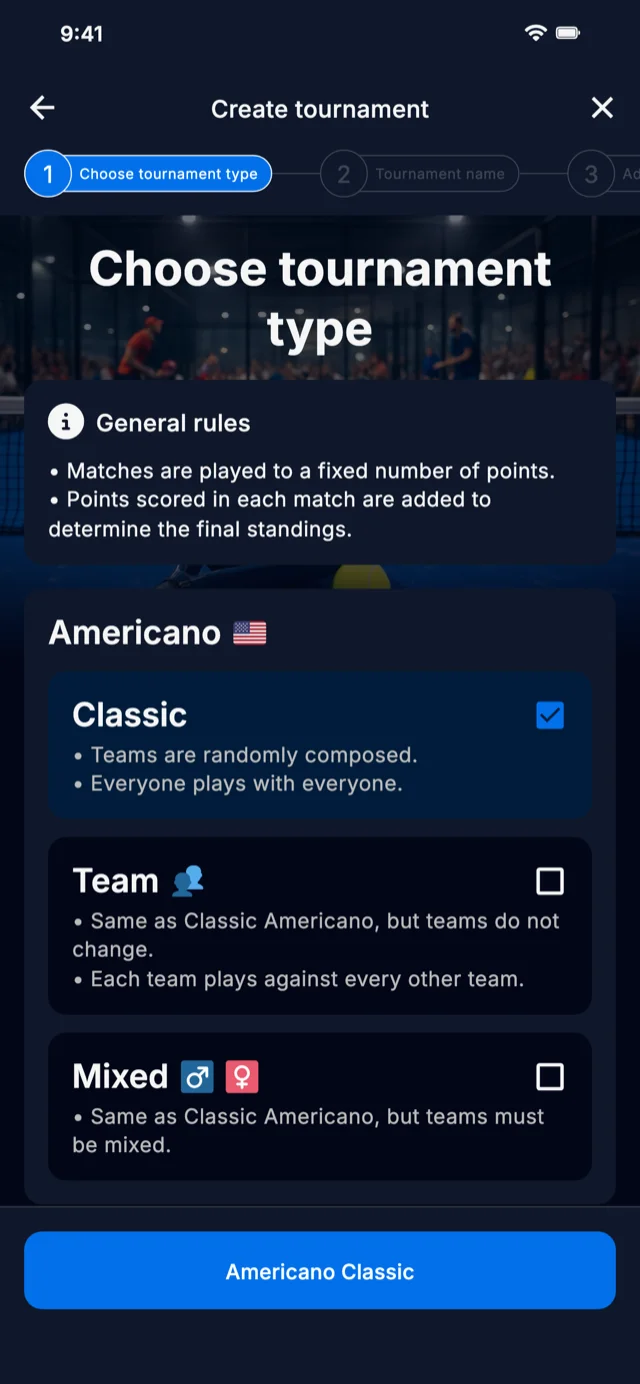
If the fixed pair is what matters most to you, the Mexicano Team variant is the one to pick. Teams are formed at the start and never change, exactly as in a pozo, and it is the teams that move between courts according to their ranking.
You then get both ingredients of a pozo: the partner you keep, and the climb towards court 1. The app works out the line ups, keeps the ranking up to date and handles up to 10 courts, with a live ranking every player can follow on their phone.
Three differences worth knowing
To stay honest about what you get:
- A pozo moves you exactly one court per round. The Mexicano reseats people by overall rank, so a very wide win can gain several courts at once.
- A pozo is played on the clock or in short games. The app’s Mexicano is played to a fixed points total per round, 16, 24 or 32.
- A pozo is won by finishing on court 1. The Mexicano is won on total individual points.
If those three gaps do not bother you, Mexicano Team will give you the same evening without a whiteboard or hand written maths. If they do bother you, run a real pozo on the board and keep the app for your other sessions.
Running a pozo at your club
A few practical benchmarks, taken from the rules of clubs that run one every week.
Numbers. Count four players per court, so a headcount that is a multiple of four. With three courts, aim for twelve players, meaning six pairs. Many clubs take entries by pair to avoid the withdrawals that leave a player on their own.
Length. Two hours is the standard, split into rounds of 15 to 20 minutes. Allow two to three minutes between rounds so pairs can change court, drink, and find their opponents.
The signal. One clock for everybody, with a horn that can be heard from every court. This is the point that ruins badly organised pozos: if each court runs its own time, the rotations fall out of sync from the second round.
The initial seeding. If you know the level of the pairs, spread them from strongest to weakest across the courts. If not, draw lots and give the format two rounds to sort the levels out by itself.
The board. A visible board showing which pair is on which court prevents every argument. It is also what gives the format its flavour: watching your pair climb towards the top of the board as the session goes on.
Pozo variants
The format is not standardised, and every club has its own recipe.
The rotating pairs pozo breaks the fixed pair rule: you keep the move up and down between courts, but partners are drawn again every round. That takes you very close to a mexicano, and it is in fact the variant an app covers best.
The coached pozo adds a coach per court or per group of courts, who corrects positioning and shots between rounds. It is a padel school format, where people come to improve as much as to play.
The mixed pozo requires one man and one woman per pair, with the same up and down mechanic. For that setup, our mixed americano guide explains how the gender constraint combines with the rotations.
Frequently asked questions about the pozo
What is a pozo in padel?
A pozo is a social tournament played by fixed pairs across several ranked courts. At the end of every round, the winning pair moves up one court and the losing pair moves down one court. The goal is to reach court 1, often called the centre court. Rounds are short, usually 15 to 20 minutes.
What is the difference between a pozo and an americano?
In an americano, you change partner every round and you score points individually, following a rotation set in advance. In a pozo, you keep the same partner for the whole session, and it is your pair that moves up or down between courts according to its results. The americano gets you meeting people, the pozo gets a duo playing together.
How many players do you need to run a pozo?
Four players per court, so a headcount that is a multiple of four. Twelve players on three courts is a common setup, sixteen players on four courts too. Below two courts the format loses its point, since there is no real ladder left to climb.
How long does a match last in a pozo?
Between 15 and 20 minutes depending on the club, with a shared horn that stops every round at the same time. Some clubs prefer a short format without a clock, such as a 10 point tie break or a best of 5 games match. A two hour session fits five to six rounds.
Do you change partner during a pozo?
No, not in the classic formula. The pair is formed at registration and stays the same from start to finish, which is precisely what sets the pozo apart from other social formats. Some clubs offer a rotating partners variant, but that moves it closer to a mexicano.
Can you run a pozo with a tournament app?
You can, but you do not need to. A pozo asks for no calculation at all: the winner moves up, the loser moves down, and everyone knows where to go without looking at a screen. A board at the side of the courts and a shared clock do the job. An app becomes useful on the formats that call for real decisions, such as varying the partners, spreading the waiting time or rebuilding the teams from a live ranking. The Mexicano in Americano Padel Manager does reproduce the up and down mechanic of the pozo, and its Team variant keeps the pairs fixed.
The pozo owes its success to one simple idea: giving every round a visible stake. You are not playing for an abstract points total, you are playing to move up a court, and everybody instantly understands where their pair stands.
If you want that dynamic without keeping the board by hand, the Mexicano format in Americano Padel Manager picks up the principle, with the best ranked players on court 1 after every round, and a Team variant that keeps the pairs together from start to finish. The app is rated 4.9 out of 5 and used in more than 75 countries, with a free download on iPhone and Android and a 7 day premium trial. To compare every formula before you choose, read our overview of padel tournament formats.