 Americano Padel Manager
Mexicano padel scoring: count points and build matches
In Mexicano, every rally won is worth 1 point and the match stops at a fixed total, usually 16, 24 or 32 points shared between the two pairs. Each player banks their team’s score on their own personal tally. That individual total then feeds the leaderboard, and the leaderboard decides who plays with whom in the next round.
That is the whole point of the format. In Americano, counting points builds a final ranking. In Mexicano, counting points also builds the next round. Here is how the chain works, from the first rally to the court sheet.

How points are counted in mexicano
The counting is identical to an Americano, and it has nothing to do with the 15-30-40 of a regular padel match.
One rally won, one point
No games, no sets, no advantage. Every rally you win adds 1 point to your pair’s tally. An opponent error, a ball bouncing twice on their side, a winning smash: everything counts the same, everything counts for one.
Players call the raw score as the match goes on, something like “12-9” or “17-15”. That is what makes the format readable for beginners and competitors alike, with no umpire and no argument about carrying games over.
The match stops at a fixed total
A Mexicano match is not played over two winning sets, but up to a total number of points shared between the two pairs. The common club settings are:
- 16 points: quick matches, around 8 minutes, useful when the group is large and courts are scarce
- 24 points: the most widespread setting, roughly 12 minutes per match
- 32 points: longer matches, around 16 minutes, suited to small groups
That number is a combined total, not a target per team. On a 24-point format, a match ending 14-10 has gone the full distance, because 14 and 10 make 24. Nobody plays to 24 on their own side.
The score is banked individually
You play doubles, but the ranking is individual. On that 14-10 match:
- both players of the winning pair bank 14 points each
- both players of the losing pair bank 10 points each
So losers never walk away empty handed. A match lost by a whisker pays almost as much as a comfortable win, which keeps everyone fighting for every rally even when the match is settled. The scale is exactly the same as in Americano, and our guide to Americano scoring covers it point by point.
What the score triggers: the leaderboard builds the next round
This is what really sets Mexicano apart. At the end of each round, the organiser does not just refresh the standings: they use them as the seating plan for the round that follows.
The first round is drawn at random
At the start of the tournament nobody has any points yet, so no ranking exists. The first round is therefore drawn at random. It works as a calibration pass: once it is done, a first leaderboard appears and the machinery can start.
That is why an unbalanced first round is nothing to worry about in Mexicano. The format corrects itself from the very next round.
The leaderboard is cut into groups of four
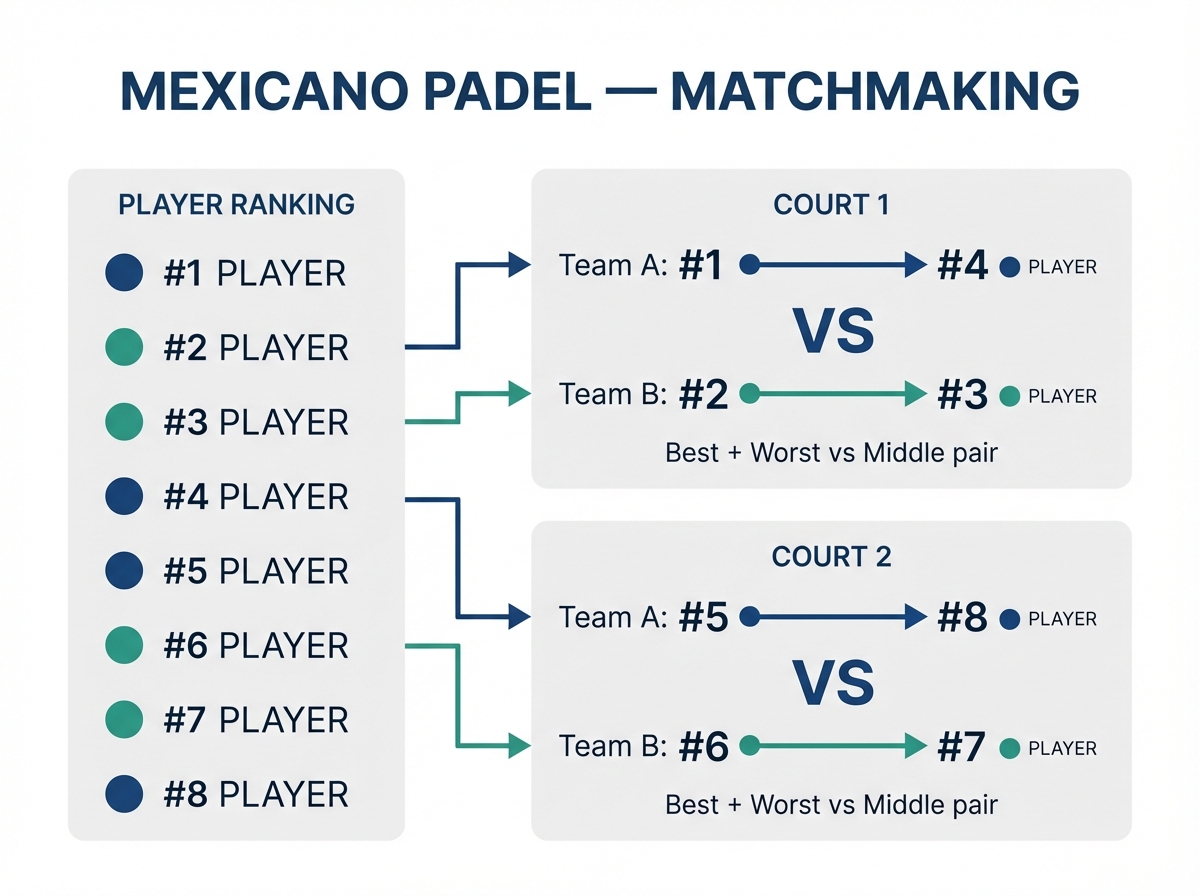
Once the standings exist, players are grouped four by four, in leaderboard order: ranks 1 to 4 together, ranks 5 to 8 together, and so on down to the bottom of the table.
Each group of four takes a court, and the allocation follows the ranking: the top group goes to court 1, the next one to court 2, and so on. That is the promotion and relegation effect you expect from a Mexicano. Winning moves you up towards court 1, stringing losses together slides you down to the lower courts.
That convergence is the real reward of the format: the further the tournament goes, the tighter the matches get, because you end up systematically facing players who have banked as many points as you.
Keeping track of all this without slipping
Recalculating a full leaderboard, cutting it into groups of four and reallocating courts after every round is doable with pen and paper for eight players. With twelve, sixteen or twenty players across several courts, the ranking goes wrong at the first missed entry, and it is always the same story: someone disputes an addition, and the tournament stops while everyone redoes the maths.
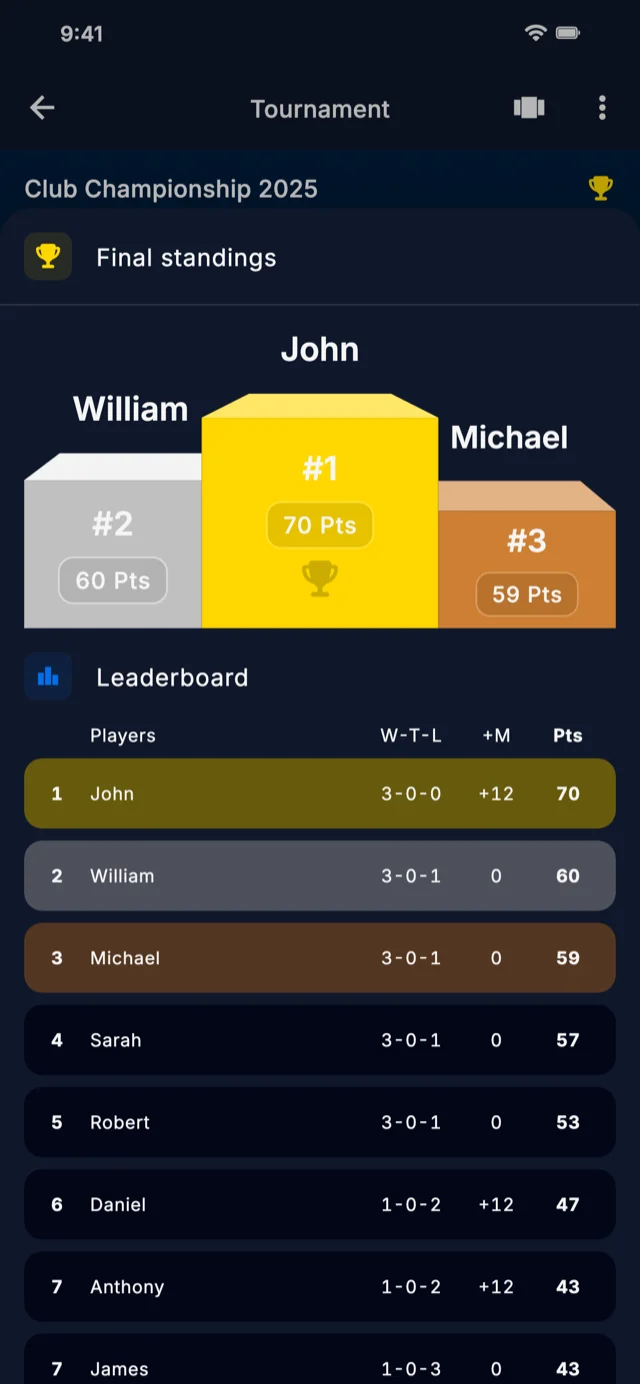
Americano Padel Manager handles that chain from start to finish. You enter each match score, something like 14-10, and the app does the rest: awarding points to each of the four players, refreshing the leaderboard in real time, then generating the next round from the updated standings and the number of courts available.
The app handles Mexicano in its three variants, Classic, Mixed and Team, on 1 to 10 courts, and works offline if the club wifi is unreliable. The leaderboard stays visible on every player’s phone throughout the session, which puts an end to the “where am I?” between matches, and it can be shown on a club TV through the share link.
The three ways to pair a group of four
Once the four players on a court are known, one question remains: who plays with whom? There are three answers, and they do not produce the same tournament at all.
Balanced: 1 + 4 against 2 + 3
The best ranked player of the group plays with the lowest ranked one, against the two players in the middle. This is the most widespread pairing, the one most clubs apply by default, and the one Americano Padel Manager offers out of the box.
The benefit: both teams have almost identical combined levels, so the match stays tight and points spread evenly. This is the setting to keep for a social evening with mixed abilities.
Challenge: 1 + 2 against 3 + 4
The two top players team up against the two at the bottom of the group. The favourite team is clearly identified, which creates a genuine challenge for the other pair.
This setting produces more lopsided matches, but it rewards performance: the best players of the moment play together. It suits homogeneous groups looking for competition rather than balance.
Alternating: 1 + 3 against 2 + 4
A middle ground between the two previous options. First plays with third against second and fourth. The gap between the teams is smaller than in Challenge, but the partnerships differ from Balanced, which varies partners over the length of the tournament.
✓ Key takeaway on pairings
Balanced for tight matches, Challenge to reward the leaders, Alternating to vary the partnerships. In Americano Padel Manager, this setting is chosen at creation and can be changed mid tournament. The change leaves the rounds already played untouched, and only affects the following ones.
In Mexicano Mixed, each team must include one woman and one man, which leaves only two possible splits of a group of four. In Mexicano Team, the question does not arise: teams are fixed, and the group simply brings together the two teams about to face each other.
A full example with eight players
Take eight players, two courts, matches to 24 points.
Round 1, drawn at random. On court 1, Ana and Bruno beat Clara and David 15-9. On court 2, Elena and Felipe beat Gaby and Hugo 13-11.
Leaderboard after round 1:
| Rank | Player | Points |
|---|---|---|
| 1 | Ana | 15 |
| 2 | Bruno | 15 |
| 3 | Elena | 13 |
| 4 | Felipe | 13 |
| 5 | Gaby | 11 |
| 6 | Hugo | 11 |
| 7 | Clara | 9 |
| 8 | David | 9 |
Round 2. Ranks 1 to 4 (Ana, Bruno, Elena, Felipe) move to court 1. Ranks 5 to 8 (Gaby, Hugo, Clara, David) go to court 2.
With the Balanced pairing, court 1 pits Ana and Felipe (ranks 1 and 4) against Bruno and Elena (ranks 2 and 3). On court 2, Gaby and David face Hugo and Clara.
Say Ana and Felipe win 14-10, and Gaby and David win 16-8. The running totals become: Ana 29, Felipe 27, Bruno 25, Elena 23, Gaby 27, David 25, Hugo 19, Clara 17.
Round 3. The leaderboard is recalculated on those totals, and the new top group brings Ana (29), Felipe (27), Gaby (27) and Bruno (25) together on court 1. Gaby, who started on court 2, has just moved up thanks to her wide win. That is exactly the intended effect.
Ties and final standings
Two players can finish a round on the same total, like Felipe and Gaby in the example above. And contrary to what you often read, point difference is useless for separating them.
Why point difference settles nothing
The football reflex is to compare points scored against points conceded. In Mexicano that calculation is pointless, and it is a direct consequence of the format.
Every match is played to a fixed total. On a 24-point format, a match always hands out 24 points between the two pairs, whatever the score. A player who has played four matches has therefore seen 96 points go by in total, their own and their opponents’ alike.
The result: if two players have played the same number of matches and hold the same total, they have necessarily conceded the same number of points, so exactly the same point difference. The criterion cannot separate anything at all.
What really separates them: the results
The only thing that distinguishes two players on equal points is how those points were earned. Two players can reach 108 points by very different routes: one by winning three matches comfortably, the other by losing narrowly five times in a row.
The order applied by Americano Padel Manager is therefore:
- the number of wins, highest first
- on equal wins, the number of draws
- on equal draws, the number of losses
That third criterion looks odd at first, since it puts the player with more losses ahead. It is deliberate, and it is elegant: a loss is still a match played. A player who joined midway through the tournament, with fewer matches behind them, naturally ends up behind those who played the whole session, without anyone having to write a special rule for their case.
Point difference only comes in as a last resort, and it only makes sense in that precise situation: between two players who have not played the same number of matches.
That is what you see on the app’s leaderboard sheet, where every player shows their points total followed by their record as wins, draws, losses.
At the end of the last round, the cumulative individual ranking crowns the winner, with no final and no knockout bracket. The player on top is the one who banked the most points across the whole session, whoever their successive partners were. If you are still hesitating between the two big families of social tournament, our Americano or Mexicano comparison details the use cases for each.
Frequently asked questions about mexicano scoring
How many points per match in mexicano padel?
A match is played to a fixed total shared between the two pairs, most often 16, 24 or 32 points. The 24-point format is the most widespread in clubs, for a match of roughly 12 minutes. A 24-point match ending 14-10 has indeed gone the full distance: 14 plus 10 make 24.
How are the next round's matches built in mexicano?
The leaderboard is recalculated after every round, then cut into groups of four players in ranking order. Ranks 1 to 4 go to court 1, ranks 5 to 8 to court 2, and so on. Within each group, the most common pairing puts the first with the fourth against the second and the third.
Is the first round of a mexicano drawn at random?
Yes. No player has any points at the start, so no ranking exists yet. The first round is drawn at random and serves as a calibration pass. From the second round on, the groups of four are built from the real leaderboard, and ability levels start to cluster.
Is the scoring different between americano and mexicano?
No, the scale is identical: 1 point per rally won, a fixed total per match, points awarded individually to each of the four players. The difference lies elsewhere. In Americano, partners follow a rotation planned in advance. In Mexicano, the live leaderboard determines the pairs and courts of the next round.
What happens in case of a tie in the mexicano standings?
The results break the tie, in this order: first the number of wins, then the number of draws, then the number of losses. Point difference plays no part at this stage, because every match hands out a fixed total: two players who have played the same number of matches with the same points total have mechanically conceded as many points as each other, so they share the same point difference.
Can you play a mexicano with a number of players that is not a multiple of four?
Yes. The groups of four are formed in ranking order, and the extra players sit out a round. The difficulty is spreading those byes fairly across the session rather than always penalising the same people. A management app such as Americano Padel Manager handles it automatically, whatever the number of courts.
Scoring in Mexicano is simple to count, one rally for one point, but it does more than crown a winner. It feeds a living leaderboard that rebuilds the courts every round and tightens the matches as the session goes on. That loop is what makes the format interesting, and it is also what makes it painful to run by hand.
Americano Padel Manager runs that loop for you: score entry, live leaderboard, next round generated according to the pairing of your choice. The app is rated 4.9 out of 5 and used in more than 75 countries, with a free download on iPhone and Android and a 7-day premium trial. To discover the format in full before you start, begin with our guide to the Mexicano rules.