 Americano Padel Manager
 Padel or paddle: what is the correct spelling?
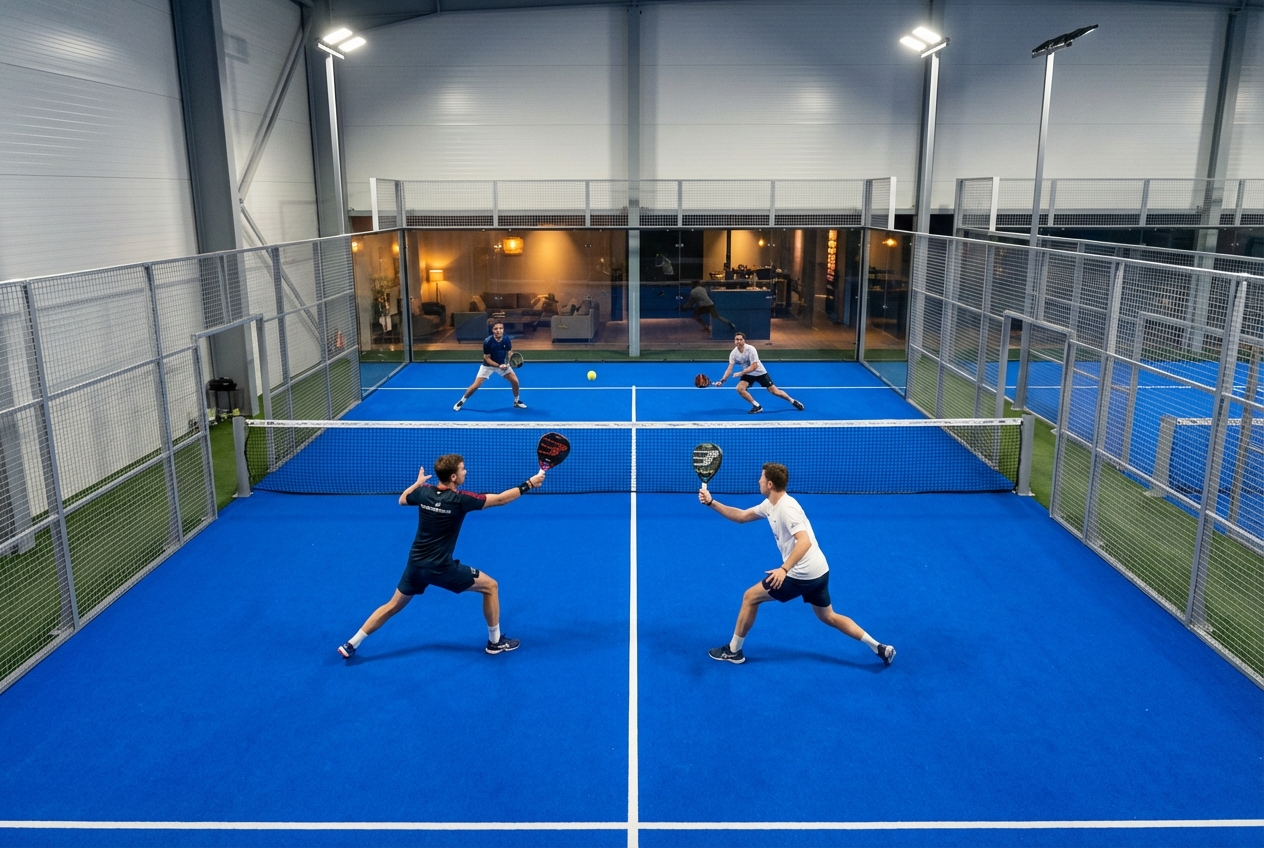
The correct spelling is padel, with a single “d” and no double “l”. The word paddle refers to an entirely different activity: stand-up paddle boarding, practised on water. This mix-up is one of the most common in the world of racket sports, and it can be traced back to a rich history involving Mexico, Spain and the English language.
Why do we write padel and not paddle?
The confusion between padel and paddle is no coincidence. The sport was long called “paddle” before its name was officially changed.
The origin of the word: from English “paddle” to Spanish “pádel”
When Enrique Corcuera invented this sport in 1969 in Acapulco (Mexico), he named it “Paddle Corcuera”. The English word “paddle” means a short-handled bat or oar. For over twenty years, everyone used the English term “paddle” to refer to this new sport.
The issue arose as the sport grew in Spain and Latin America. In Spanish, “paddle” does not fit natural pronunciation patterns. The word was gradually hispanicised into “pádel”, which better suited Spanish phonetics.
1993: the RAE makes “pádel” official
The decisive turning point came in 1993. The Spanish Sports Council recognised padel as an official sport, and the Real Academia Española (RAE), Spain’s equivalent of the Oxford English Dictionary authority, added the word “pádel” to its dictionary. The spelling “paddle” was dropped in favour of “pádel” to comply with the rules of the Spanish language.
Since then, this spelling has become standard worldwide. The International Padel Federation (FIP) uses “padel” exclusively. Dictionaries in many languages have followed suit, adopting the word in this form.
Today, writing “paddle” when referring to the racket sport played in an enclosed court is simply incorrect.
The history of padel: from Mexico to the world
Understanding the history of padel helps explain why its name changed and why so many people still confuse it with other sports.
1969: Enrique Corcuera invents “Paddle Corcuera”
It all began in Acapulco, Mexico. Enrique Corcuera, a Mexican businessman, had a squash court at his home. Tired of losing balls and watching plants encroach on the playing area, he built concrete walls around his court and adapted the rules of squash and tennis.
His wife, Viviana, wrote the first official rules of the game. The sport was born, under the name “Paddle Corcuera”.
1974: padel arrives in Spain and then Argentina
Alfonso de Hohenlohe-Langenburg, a German-Spanish prince, discovered padel at Corcuera’s home during a visit to Acapulco. Captivated by this new sport, he built the first two padel courts in Europe at a tennis club in Marbella (Spain) in 1974.
From Spain, padel quickly spread to Argentina, where it became a genuine cultural phenomenon. Argentina remains one of the countries where padel is most widely played, with thousands of clubs across the country.
The worldwide explosion
Since the 2010s, padel has experienced extraordinary growth on a global scale. The sport is now played in over 90 countries, with professional circuits such as Premier Padel and the World Padel Tour. Countries like Sweden, Italy, Portugal and the United Arab Emirates have seen the number of courts skyrocket in just a few years.
This rapid expansion partly explains the linguistic confusion: each country initially adopted the English term “paddle” before gradually switching to the official spelling “padel”.
Padel, paddle tennis, stand-up paddle: stop confusing them
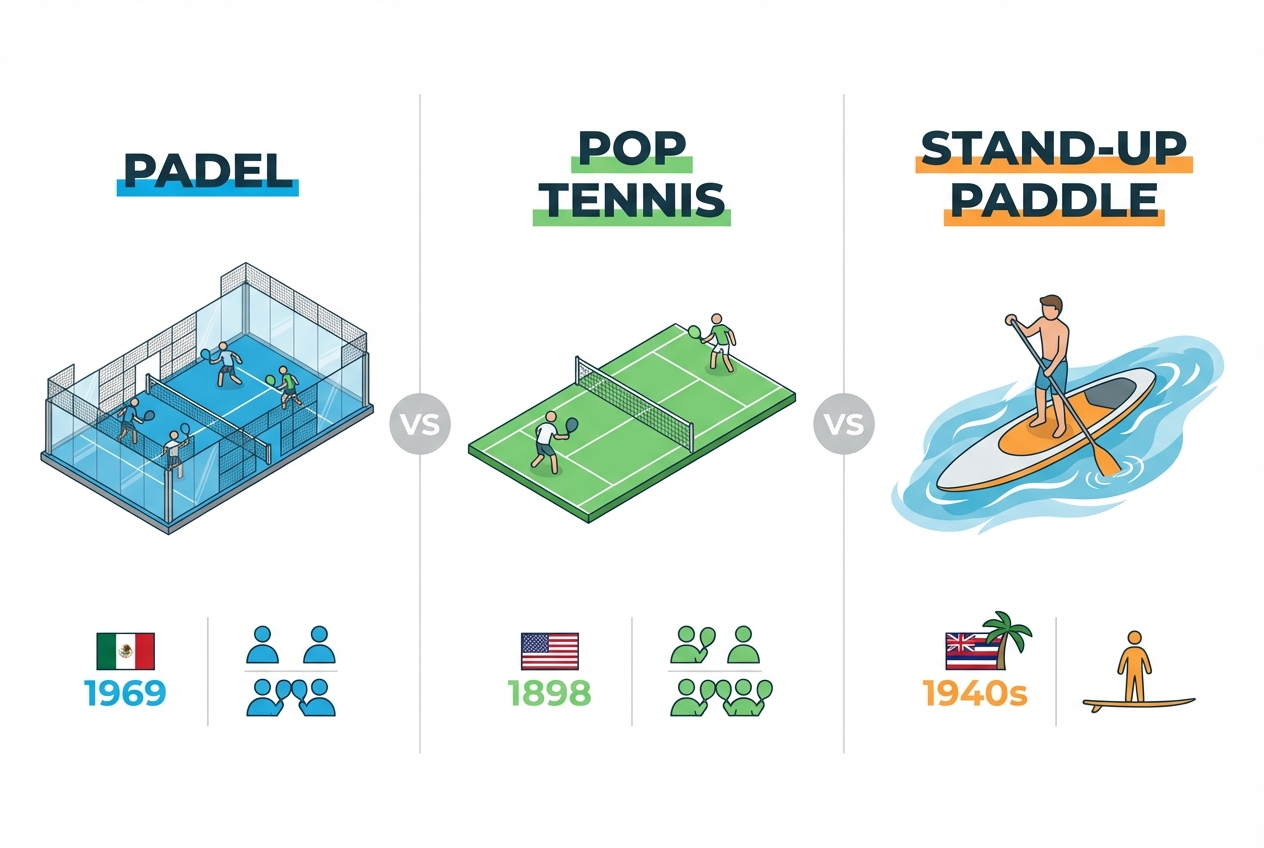
The confusion between “padel” and “paddle” is amplified by the existence of three completely different sports that share a similar name.
Padel (racket sport in an enclosed court)
Padel is played in doubles (2 vs 2) on a court measuring 20 x 10 metres surrounded by glass walls and wire mesh. The walls are an integral part of the game: the ball can bounce off them, as in squash. Players use a pala (a solid racket with no strings, perforated with holes) and balls similar to tennis balls but with slightly lower pressure.
Paddle tennis (POP Tennis since 2015)
Paddle tennis is a sport invented in 1898 in the United States by Reverend Frank Peer Beal. It is played on a court smaller than a tennis court, without walls or glass. The racket is thinner than a padel racket, and the ball is softer.
In 2015-2016, the US Paddle Tennis Association renamed this sport “POP Tennis” precisely to end the confusion with padel. Despite this change, many people still call it “paddle tennis”.
Stand-up paddle (water sport)
Stand-up paddle (SUP) has nothing to do with racket sports. It is a water sport where you stand on a board and paddle. Yet this is the sport many people picture when they hear the word “paddle”.
Comparison table
| Padel | Paddle tennis (POP Tennis) | Stand-up paddle | |
|---|---|---|---|
| Invented in | 1969 (Mexico) | 1898 (United States) | 1940s (Hawaii) |
| Court/venue | 20 x 10 m, glass walls | Smaller court, no walls | Water (sea, lake, river) |
| Equipment | Pala (solid perforated racket) | Thin solid racket | Board + paddle |
| Players | Always doubles | Singles or doubles | Individual |
| Ball | Similar to tennis | Softer | None |
Organise your padel tournaments with Americano Padel Manager
Now that you know the difference between padel and paddle, let us move on to the practical side. If you organise padel Americano or Mexicano tournaments, the Americano Padel Manager app simplifies all the organisation.
In less than 2 minutes, the app automatically generates matches with optimal player rotation, manages the live leaderboard and lets you share results instantly with all participants. Whether you are a club or a group of friends, the app scales from 4 to 40 players and supports up to 10 courts simultaneously.
No need for Excel spreadsheets or wall charts. Americano Padel Manager is available for free on iOS and Android. And if you are new to the Americano and Mexicano formats, check out our complete guide to Americano rules.
How to pronounce padel correctly
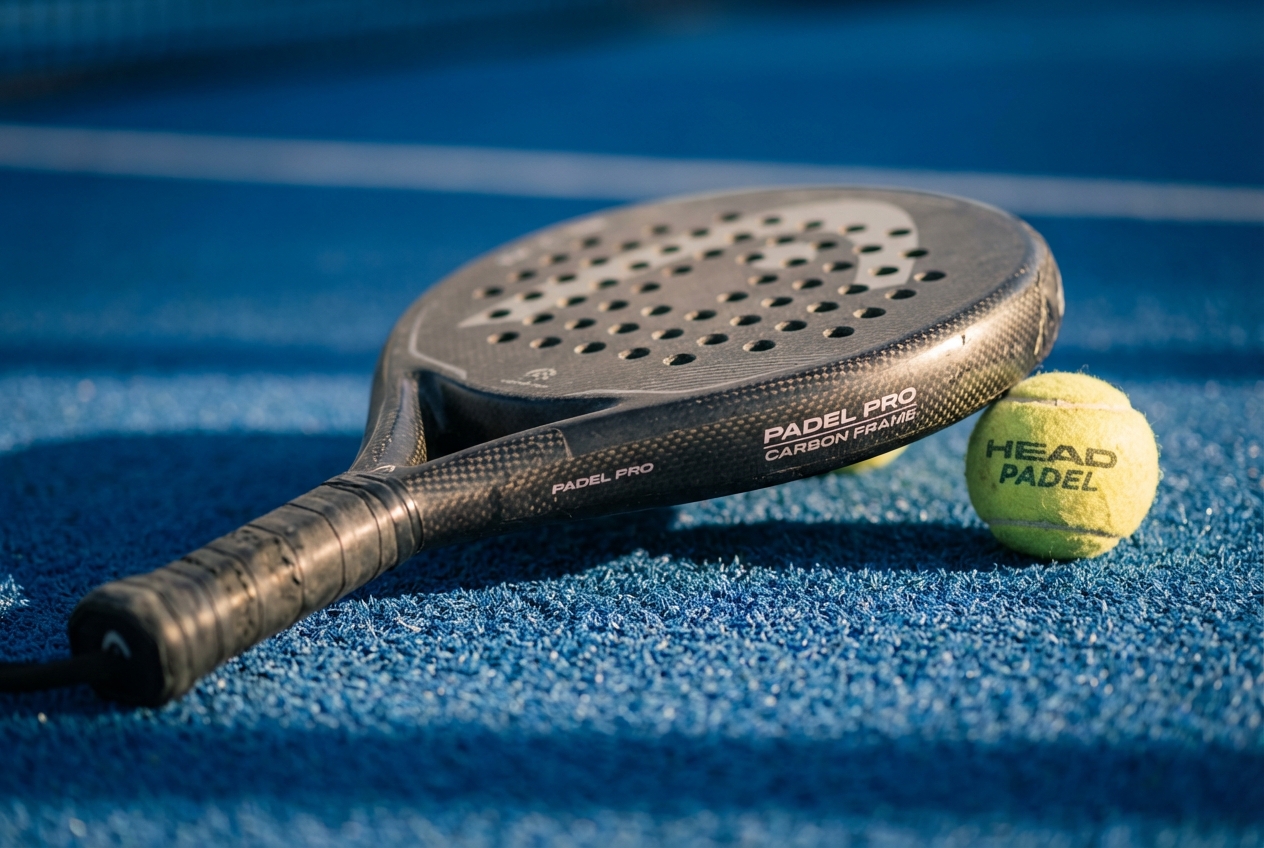
Beyond the spelling, the pronunciation of the word padel also raises questions. Here is how to say it properly.
The correct pronunciation is [pa-DEL], with the stress on the second syllable and an open “e” (as in “bell”). This pronunciation follows the Spanish phonetics of the word “pádel”, the language in which the sport developed.
⚠️ Common mistakes to avoid
Do not say “paddle” (the English word for a short oar) or “pa-DEEL” (stretching the vowel). The correct pronunciation rhymes with “model”, not with “noodle”.
The confusion often stems from the influence of the English word “paddle”. But since the sport is called padel and not paddle, it makes sense to pronounce it the Spanish way.
For the curious: in Spanish, the stress falls on the first syllable (“PÁ-del”), because the word carries a written accent. In most other languages, the stress naturally falls on the second syllable, giving “pa-DEL”. Both pronunciations are accepted.
Frequently asked questions
What is the difference between padel and paddle?
Padel is a racket sport played in doubles in a glass-enclosed court measuring 20 x 10 metres. Paddle (or stand-up paddle) is a water sport where you stand on a board and paddle. They are two completely different sports that share a similar name because of their common English etymology.
Why do we say padel and not paddle?
The word “padel” comes from the hispanicisation of the English word “paddle”. In 1993, the Real Academia Española officially adopted the spelling “pádel” to adapt it to Spanish phonetics. Since then, this spelling has been adopted by the International Padel Federation and by dictionaries worldwide.
How do you pronounce the word padel?
The word padel is pronounced [pa-DEL], with an open “e” as in “bell”. You should not pronounce it like “paddle” (the English word) or “pa-DEEL” with a long vowel.
Are padel and paddle tennis the same thing?
No. Padel was invented in 1969 in Mexico by Enrique Corcuera and is played in a glass-enclosed court. Paddle tennis was invented in 1898 in the United States by Frank Peer Beal and is played on an open court, without walls. Since 2015, paddle tennis has been renamed “POP Tennis” to avoid this confusion.
Now you know that the correct word is padel, how to pronounce it, and why you should not confuse it with paddle tennis or stand-up paddle. All that is left is to play. Download Americano Padel Manager for free and organise your first tournament in minutes. You can also discover the differences between padel, pickleball and squash or learn about the padel scoring system.